Showing posts with label Spain. Show all posts

Thursday, 16 July 2026

Palaces

 See It On A Postcard's Thursday Postcard Hunt - Architecture - Palaces

The monumental Winter Palace in St Petersburg, the former main residence of the Russian royal family on the south bank of the Neva River. Today of course it is part of the Hermitage Museum complex.


The Royal Palace of Aranjuez one of the official residences of the Spanish royal family. It looks a wonderful entrance into the square for high stepping horses. There is a museum on the ground floor and the rooms and gardens are open to the public.

Thursday, 12 February 2026

South

 See It On A Postcard's Thursday Postcard Hunt for Cities in Southern Europe

Night falls in Toledo which is surrounded on three sides by the Tagus River. The Alcazar fortification dominates the highest part of the city, always a useful location if under siege, as has happened in past.  The cathedral occupies the other high point.
Arezzo in Tuscany described a destination for "culture without the crowds". The view is of the arcades of Via Roma, a covered shopping street. A  welcome cafe-bar beckons in the distance to rest those tired tourist feet. 

Thursday, 7 August 2025

Map the World

 See It On A Postcard's Thursday Postcard Hunt on this month's theme - Illustrations;  Week 1 - Maps

Moominland Midwinter
Sensibly the Moomins sleep through the winter but one year Moomintroll wakes up and cannot get back to sleep, goes outside, and does not recognise this world of white which seems empty and feels lonely and frightening, but it is not long before someone appears. The Moominland Midwinter book, was published in 1957 with map and illustrations. Tove Jansen dedicated it to her mother. The perfect book for the winter season.
Welcome to Andalusia
Time to head for the sun and sea of Spain for a map one could use for exploring the real world.

Thursday, 1 August 2024

Memorialised

 See It On A Postcard's Thursday Postcard Hunt is in search of statues and memorials

Plaza de Espania
and in Spain with their heads in the clouds Don Quixote and the Sancho Panza ride out from the pages of Cervantes,  forever in the search of adventure.
Glentrool Forest Park
The clouds of  an ancient conflict settle over the Bruce Stone in remembrance of Robert the Bruce who defeated English forces in Glen Trool (1307).  A monument to look at and read before starting the popular walk up the boggy narrow valley to ascend The Merrick, southern Scotland's highest peak. A panorama of the Galloway Forest, Ireland and the Isle of Man is promised on reaching the top. It all depends on the weather. Many years ago we viewed and read the granite stone in sunshine however on reaching the top the clouds and mist had descended.

In Sri Lanka the seated Buddha of Gal Vihara teaches the lesson that all is impermanence and transitory. This is one of four images carved on a single large granite rock face in the ancient city of Polonnaruwa.. It is thought that they were once coated in gold.  Time for contemplation over a nice cup of  Ceylon tea.

Sunday, 4 February 2024

Harbour Lights


1968: Centenary of Esbjerg Harbour (Design - M Stage; Engraver - Cz Slania)

This harbour light has seen many changes in 100 years, Esbjerg was once home to 600 fishing vessels but in contrast today it is one of the world's largest shipping ports for wind turbines.

1987: Views
Sailing in Havelet Bay, I think the harbour light in the background is the approach into St Peter Port
2003: Europa: Six Decades of Tourism Poster Art

which could be this one which featured on a 2002 poster when Guernsey Tourism's theme was 'Naturally Guernsey'
1986: Tourism Series
The cancel hides the attractiveness of Calella Lighthouse (inaugurated in 1859) which can be seen here, although one of our number will know this already.

Sunday Stamps theme this week is - Lighthouses - See It On A Postcard


Sunday, 8 January 2023

Geology


1969: East German Minerals

A piece of calcite

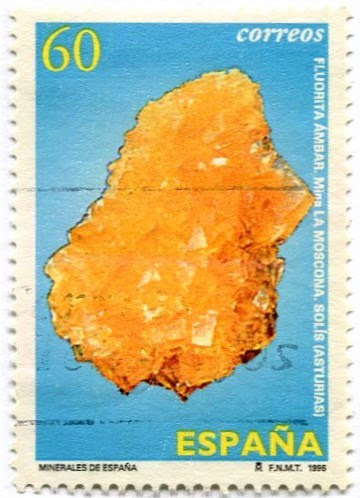
1996: Minerals

and the amber of this fluorite, sometimes called the most colourful mineral in the world for the variety of its shades and colours
1961: Definitive - Finger Rock
 

Once a big tourist attraction here is Mukurob - Finger of God, a sandstone example of a  magnificent balancing act, alas in 1988 it collapsed.  That is our planet, always on the move...

1975: The Volcanic Eruption on Heimaey

The volcanic island of Heimaey. In the 1970s it had a population of 5,200 who were woken up at 2.00 am on 23 January 1973 when the volcano erupted for the first time in recorded history.  Fortunately the entire fishing fleet was in the harbour for the night and was able to carry everyone to mainland safety, most of them would eventually return.

Sunday Stamps theme this week is - Geology - See It On A Postcard


Sunday, 15 August 2021

Out of this World


1985: Expo 85 World's Fair Tsukuba, Japan (Design Yury Artsimenev)

For the World Fair in Japan Russia decided to go into space with cosmonauts and

the Molniya 1 (Lighting) communication satellite. ( It is  a mystery to me how I read the Sunday Stamps prompt as a W, I blame my new glasses and worsening eye sight, but at least there is an M on this stamp)

Russia went futurist with 'Energy Sources of the Future' and

a city of the future which doesn't look like anywhere one would like to live without a jet pack. It it is in the shape of a leaf. I wonder what that means? Is it organic?
1992: Expo 92 in Seville

For Expo 92 in Spain the theme was 'The Age of Discovery' which celebrated the 500th Anniversary of Christopher Columbus reaching the Americas from the port of Seville. Here we are setting sail from our blue planet to Mars.  Yay another M. 

Sunday Stamps II theme this week turns out to be - the Letter M-  more at See It On A Postcard


Sunday, 18 July 2021

Stamp Travels


1902-1914: Railway Parcel Stamp (Design Francois Poortman)

I  may have taken the Sunday Stamps theme 'issued in the 1900s' too literately I discover but enjoyed delving back to the first decade of the 20th Century. So, all aboard the steam train we are travelling in the parcels van on Belgium's extensive rail network. Almost seems a shame to use this lovely stamp on a parcel

as it will get a sturdy postmark.Thwack. I enjoy the romance of all those different place names. The square oblong postmarks are the railway service cancels, the post office used round cancels.

Underneath this cancel is a winged rail wheel which would become a familiar motif on Belgium parcel stamps.  I will continue my journey through the Belle  Époque and visit

1907: Industrial Exposition

Spain. These stamps were issued at the 1907 Industrial Exposition for purchase by collectors but not issued by the Spanish postal service and not valid for postage. A memento of a visit. They show King Alfonso and Queen Victoria Eugenia (granddaughter of GB's Queen Victoria).
1906: 40 Years Rule of Prince and King (Design I Pompilian)

More royalty as  Prince Carol I meets Osman Pasha at the end of the Russo-Turkish War (1877-78) also called in this context the Romanian War of Independence.  Carol was Marshal of the Russian troops and commander of the Romanian forces.

1908: King Carol I (Design I Pompilian Engraver G Popescu)

Here his beard has grown lush. Ruled as prince from 1866-1881 and king from 1881-1914.

Sunday Stamps II theme this week is - Issued in the 1900s - travel back to See It On A Postcard


Sunday, 1 July 2018

Tents

1959: Living in Tunisia (Design- Yahia Turki)
Time to pitch ones tent and in the Tunisian stamp the tent is on the outskirts of the city of Kairouoan, a UNESCO World Heritage Site. The painter is Yahia Turki (1903-1969)  a modernist artist who has been called the 'father of Tunisian painting' and whose artistic life Tunisia celebrated in 2003 issuing a stamp for his birth date.  Apart from the camel the site seems deserted
2007: Europa - 100th Anniversary of Scouting (Design - Matjaž Učakar)
but there is a full camp here with this happy group enjoying life together around a scout camp fire.
1983: 75th Anniversary of the Scout Movement
Tents and fire also make an appearance on this Spanish stamp. I rather like the Scout flag and scarf forming a 75.
And this looks the perfect spot to set up camp.
1978: 50th Anniversary of Girl Guides (Design - TF Johannesen)
Or here under a full moon.
not to forget the numerous guiding songs to be sung around a fire and that does look like a very fancy fire indeed in the photo.  No way are you going to be able to swing a billy can over that
2007: Europa - 100th Anniversary of Scouting
although one may be able to lash something together. I notice from the postmark the stamp above has travelled from Haute-Savoir region of France, another great place for outdoor adventure.
1974: Rural America (Design - John Falter)
But for a large gathering of people you need a really big tent. The stamp celebrates the centenary of Chautauqua, a movement that brought together entertainment and education for the people, a section of which travelled around the country. The artist, John Falter, remembered as a boy going to the Chautauqua with his mother when it came to his home town of Falls City, Nebraska. He incorporated part of his Falls City home and the nearby water tower in the background of the stamp.


Sunday Stamps II prompt this week of the Letter T - for Tents and Tunisia - pitch up at See It On A Postcard

Sunday, 28 February 2016

Puzzlers

If one cannot make head nor tail of a stamp generally you know what country it originated from. Not in this case for it is hidden under a deep black stripe.  I found this amongst a mixed bag of stamps, so no clues there. Being a bit nerdish I can't mount a stamp in an album if I can't put it in a context so had to look for another clue, otherwise it would have to continue to languish in the bag, but at least it used the Latin alphabet so maybe that would be a starting point, plus the date of the overprint, 1941 (the coat of arms meant nothing to me).  The first clue was the bottom line which of course I typed into the search engine and it told me that this was a painting by Velasquez 'Vulcan's Forge' so we may be in Spain.  A bit of Google translate and the other line came up 'Home and School for Orphans'.  Hey ho that didn't help much but to cut a very long search story short it turned out this was a stamp issued in 1938 during the Spanish Republic (Popular Socialist) as a charity stamp (hence the School for Orphans) but after the end of the Spanish Civil War, and later in 1941, the remainder were overprinted with the black bar to delete the inscription 'Republic Español' by Franco's government but were never issued.

The next stamps I show did not have the benefit of a Latin alphabet but
that hammer and sickle may be a clue although they came out of an old stock book which consisted of countries starting with the letter A, well that rules Russia out, or does it?  These are stamps of Armenia which mark the start of a  brief period of calm after the turbulent years  of conflict and genocide under the Ottoman Empire when in 1922 they became the Soviet Republic of Armenia, and part of Russia (things would deteriorate after the death of Lenin).  These stamps of 1922 were in fact not officially issued without having surcharges of gold kopeks in figures so are a bit of a Cinderella stamp.  On the left is a mythical beast on a wall sculpture from the ruined medieval city of Ani and of course the other is the Soviet Symbol on a design of an old Armenian manuscript.
The other stamps of the set I have are less mysterious, an Armenian Red Soldier and a Fisherman on the River Aracs.

But enough of conflicts, I'll finish with a more modern Swiss stamp but won't leave you puzzling
c1995: "A" (1st class) Mail
An entry to Sunday Stamps II theme - Oddities (the unknown, unusual or strange) - more randomness here at See It On A Postcard         

Sunday, 10 August 2014

The Deep

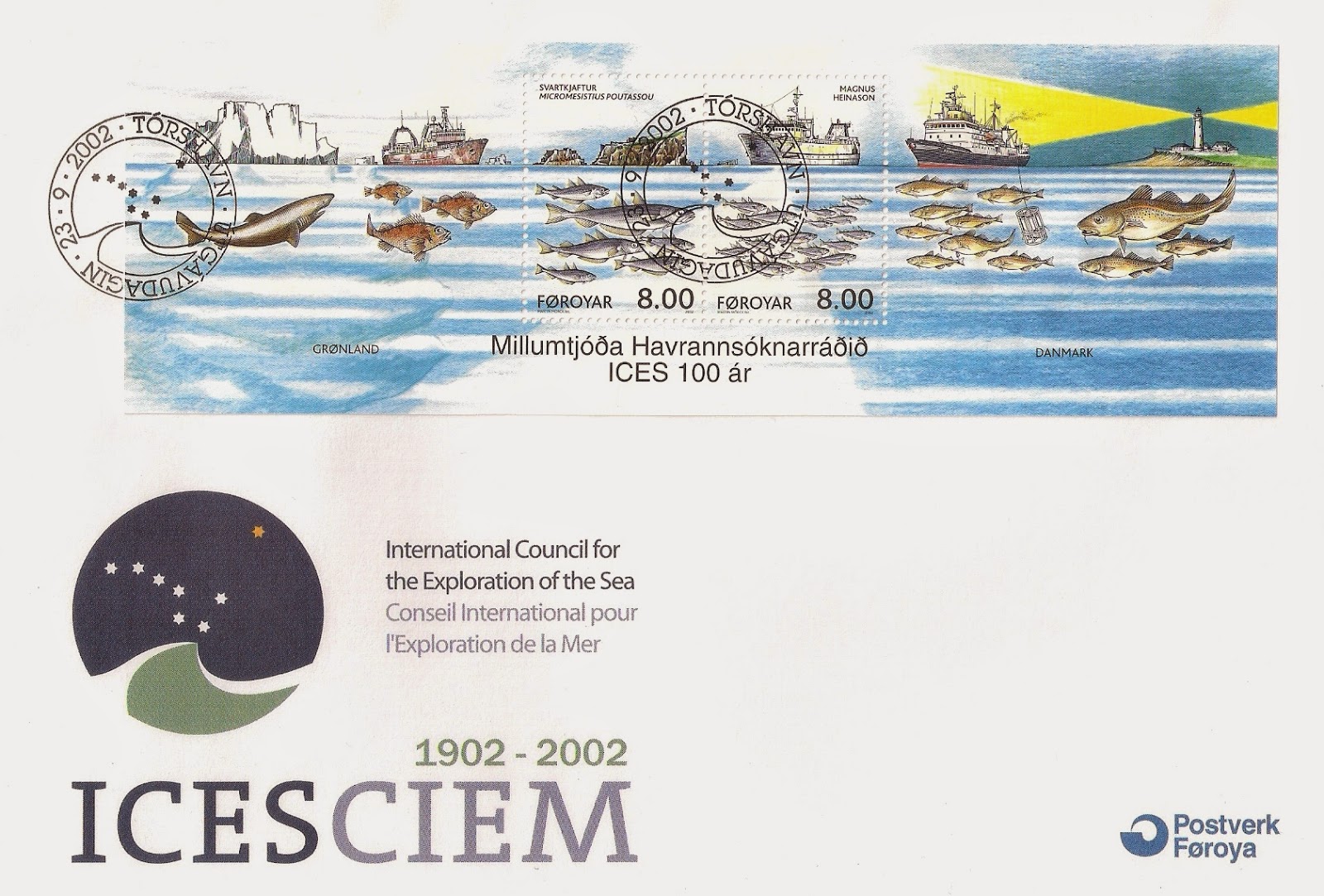
The International Council for the Exploration of the Sea (ICES)  is the world's oldest scientific intergovernmental organisation and its objective is the sustainable use of the oceans and increase of scientific knowledge. Founded in 1902 to study and advise on marine science in the Atlantic, Baltic and North Sea, it now includes the Arctic in its remit. Three countries of the founding members of ICES commemorated its 100 years by jointly issuing the same miniature sheet but each taking two different sections to make the whole scene.
The Faroe Islands two stamps appear in the middle of the miniature sheet.  On the left -  Blue Whiting (a member of the cod family) who swim near the surface at night and migrate to the bottom during the day.  The stamp on the right features Atlantic Cod and a marine research ship named after Magnus Heinason, a 16th Century Faroese naval hero and privateer.  The ship's home port is Torshavn and at the moment it is at sea just to the north of the Faroe Islands.  
  The Greenland section of the sheet on the left  show a Greenland Shark and Deepwater Redfish.  On the right is where Denmark's two stamps would appear and show Atlantic Cod with the rays of the Hirtshals lighthouse and the marine research ship Dana whose home port is the town of Hirtshals on the Jutland peninsula. Curious to know where it is at the moment?  Looking on the Marine Traffic site it seems to be slap bang in the middle of the North Sea in-between North East England and Denmark.

ICES requests countries to reduce or stop fish catches for certain species based on its research and statistics, whether they do so is another matter.  Spain issued a "Marine Species in Danger of Extinction" in 2013 featuring species on the edge

Top left - Basque Whale who live in shallow coastal waters and in the summer move to the colder water of the North Atlantic.
Top right - Bluefin Tuna, native to the Atlantic and Mediterranean and whose numbers have been decimated by overfishing
Bottom left - Monk Seal, lives in the Mediterranean and at great risk of extinction. The world would be a poorer place without the chance of seeing a seal. 
Bottom right - Sea Lamprey - an anadromous species like the salmon which spawns in rivers and migrates to the sea.  It did freak me out as a child when I saw a picture of its suction cup mouth and the result of it attaching to skin and rasping away at tissue with its sharp tongue and teeth.  I have since seen one in reality coiling out of a rock but happily there was a sheet of glass between us and it looked rather languid. 

I will finish with the more curious sea creatures on Albania's 1968 Marine Fauna series
 the Squid, Lobster and Northern Whelk
Spiny Lobster and Green Crab

An entry to Viridian Postcard's Sunday Stamps theme of - Undersea Life here

Tuesday, 6 March 2012

Tilting at Windmills

From the wonderful world of imagination Don Quixote de la Mancha and his trusty squire Sancho Panza on his mule continue their ride in the Plaza de España in Madrid underneath a monument to their creator Miguel de Cervantes.  Forever fighting with 
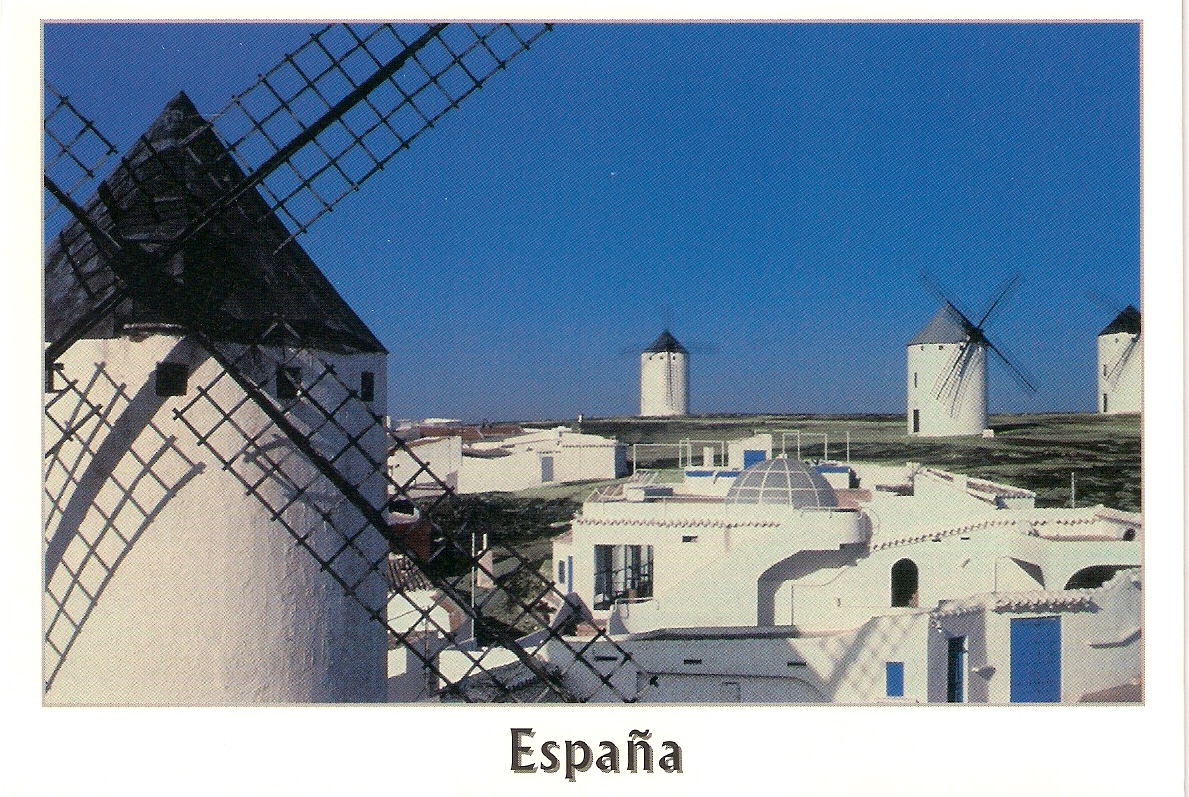
 Campo de Criptana
windmills thinking they were giants.  These are some of the famous windmills of La Mancha in central Spain. Each of the windmills has a name and at one time there were 34,  today there are about 10 all with their machinery and structure preserved.  La Mancha is very dry and hot in the summer, I imagine being inside one of the windmills would be a good way to cool off, after admiring the shape and their pristine white against the deep blue sky.

An entry to Jocelyn's Cuckootree "Our Wonderful World"