Showing posts with label Mythology. Show all posts

Wednesday, 3 June 2020

Life in the Slow Lane

2009: Mythical Creatures
Mail Adventures asks which one stamp explains your life in the recent weeks or months.  Well it might be this one as things have certainly slowed down to a snails pace and any adventure available is only taking place in my head.  See that unruly hair?  Nothing compared to my lockdown hair. Despite hairdresser warnings I may snap any time and head for the scissors.

Sunday, 13 October 2019

Here Be Dragons

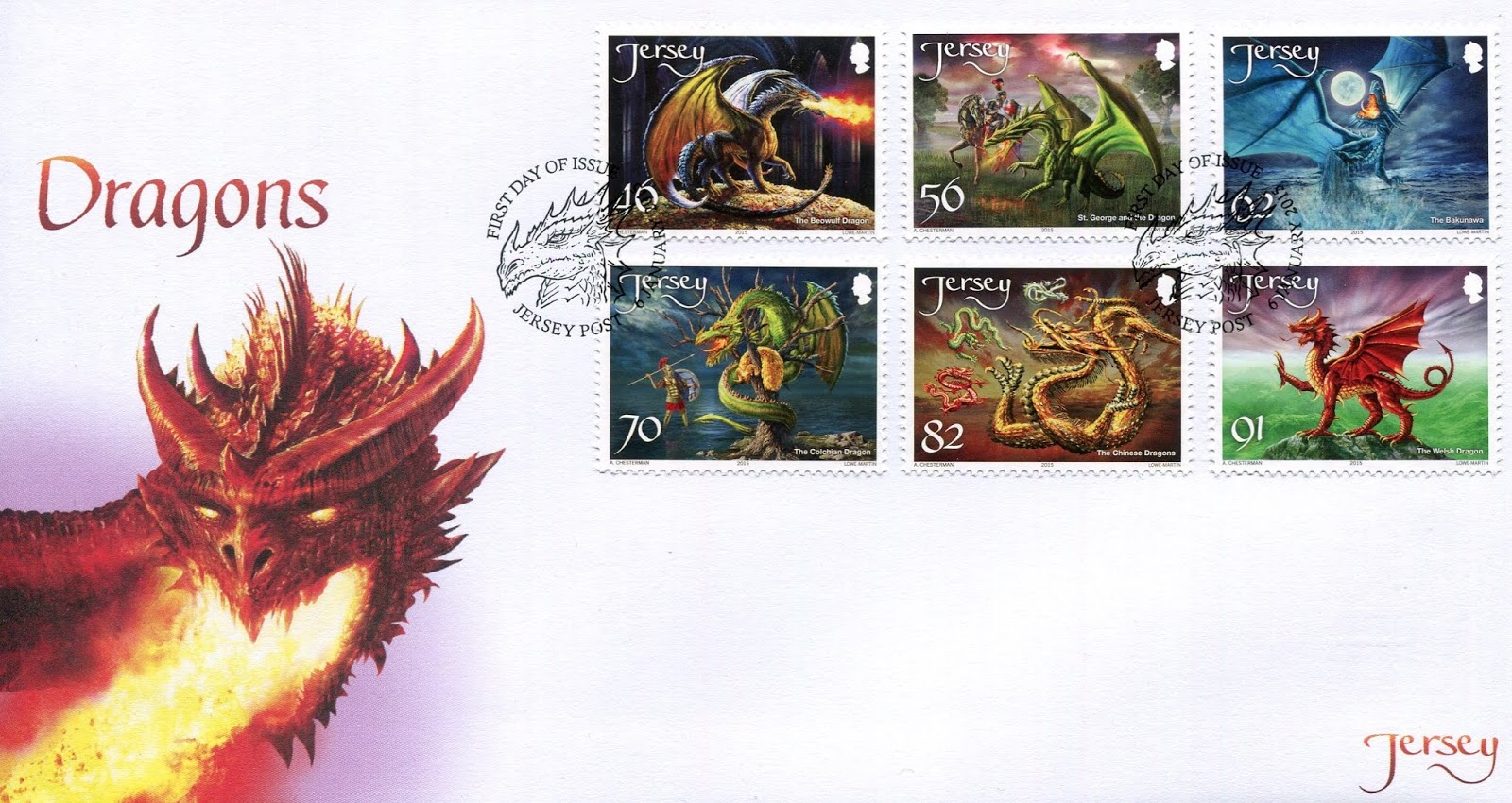
2015: Dragons (Illustrator - Adrian Chesterman)
The artist Adrian Chesterman specialises in fantastical realms and for Jersey Post he created six legendary dragons.
First (40) - is a dragon from the Anglo-Saxon epic poem Beowulf (spoiler alert, they both die at the end), (50) is George and the Dragon (only the dragon dies), we next travel to the Philippines (60) - The Bakunawa is believed to be the cause of eclipses, earthquakes, rain and wind.
Greek myth gives us next (70) - The Colchian Dragon which guarded the Golden Fleece, it was said to never sleep but the witch Medea put it to sleep with magic and drugs while Jason stole the fleece. European dragons are often perceived as evil and dangerous but - (82) The Chinese Dragon can be beneficial, spiritual and even sacred. The different colours have different meanings. Lastly is a Celtic dragon - (91) The Welsh Dragon whose origin may be the Great Red Serpent god Dewi.

The word dragon originates from the ancient Greek word drakon which translates as 'a giant monster  serpent-like creature' so lets see one
1970: The Labours of Hercules
The Lernean Hydra, a water serpent with fatally venomous breath said to have between 5 and 100 heads with one immortal head.  The stamp shows Hercules performing his second labour where he cuts off its heads with the help of his nephew (and one of the argonauts) Iolaus who singes the stump with a burning firebrand to prevent new heads growing.  (The illustration is taken from an ancient Greek storage vase/stamnos).   I hope you are not going to have nightmares after seeing this writhing water beast from the swamp of Lerna.
1990: Greeting Stamps - 'Smiles'
Here is something more benign, the Cheshire Cat with the handy knack of being able to disappear when something nasty appears.
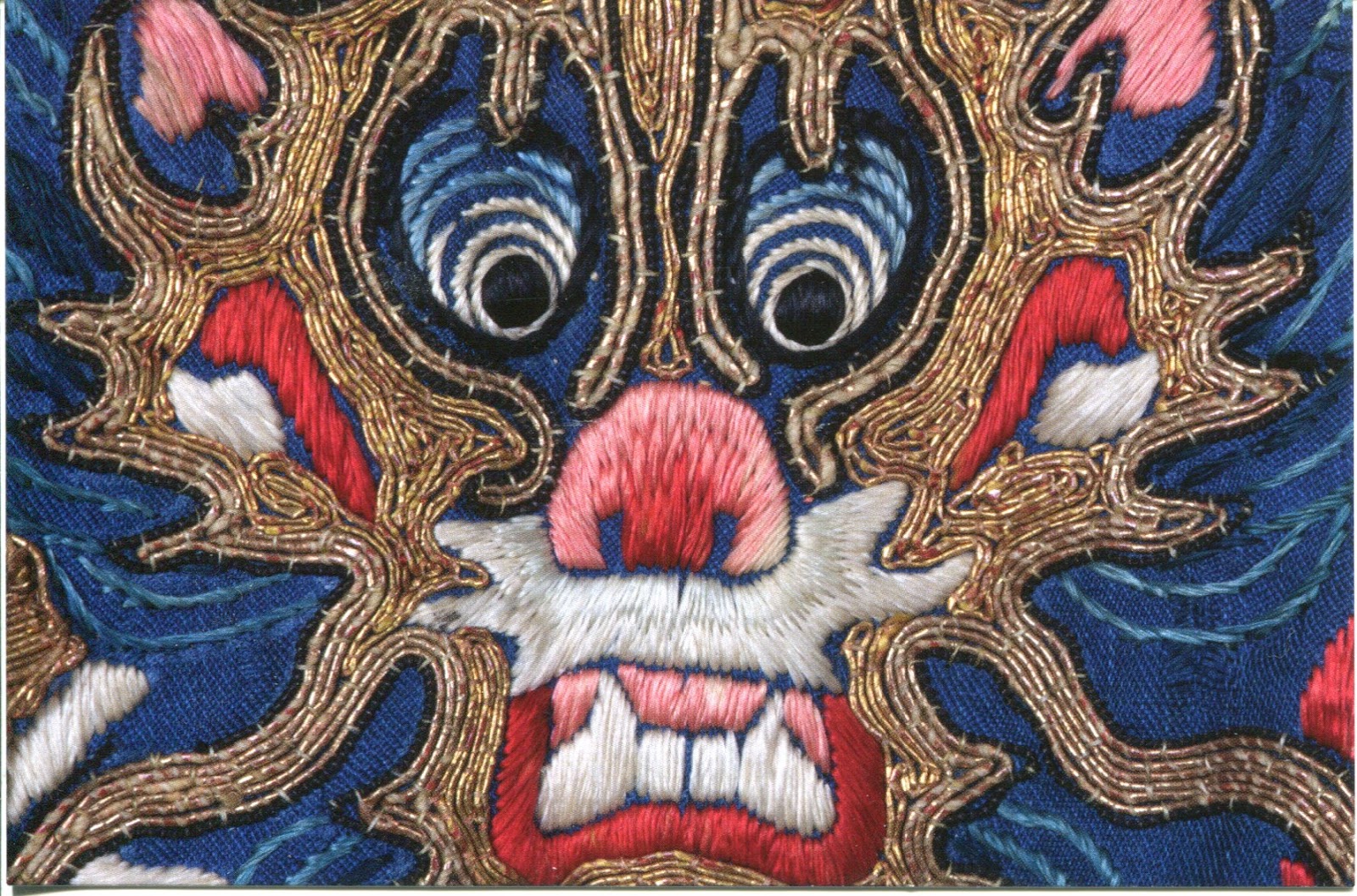
Postcard - Detail from a silk Chinese Dragon Robe


Sunday Stamps II theme this week is - Dragons, Mythical Beasts or Dinosaurs -  gaze on them at See It On A Postcard  
   

Sunday, 8 September 2019

Red

1979: Airmail - "Planet Exploration"
The Mars 3 robotic space probe flies above the red planet.  The descent module would eventually land but unfortunately in the middle of a Martian dust storm which was probably the reason it only managed to transmit for 20 seconds.
1973: Exploration of Venus
Another day another planet this time the more hostile Venus. I think this stamp set celebrates the Russian Venera programme, the most extensive exploration of one planet which took place from 1961-1985 and consisted of 3 atmospheric probes, 10 landings, 4 orbiters, 11 flybys and even 2 balloon probes into the clouds. Did someone say balloons?
1982: 200th Anniversary of Manned Flight - Balloons
The Royal Vauxhall Balloon which in 1836 Charles Green and crew of two set off from the Vauxhall Pleasure Gardens across the channel and eighteen hours and 480 miles later landed in Germany.  This set a new record which lasted until 1907.
1990: Butterflies "Polygonia c-album"
Of course if you are a Comma butterfly then flying comes easy and it always amazes me the distances these tiny creatures can cover
1982: Roses (Design - Heinz Schillinger)
Perhaps they will be attracted to the scent of a Bourbon rose in a garden but
2001: Carnivorous Plants (Design - Steve Buchanan)
not be lured by a Venus Flytrap. Yikes -
1984: Traditional Dance Masks
Zamindi, a 'dreadful god' with ripper teeth and five skulls but on the good side she does have the eye of wisdom in the middle of her forehead.


Sunday Stamps II prompt this week is - Red - See It On A Postcard 


Sunday, 2 June 2019

Osterreich in Outer Space

1982: UN Space Conference in Vienna (Design - Otto Zeiller)
Austria and outer space is something which does not immediately spring to my mind however I would be wrong as  it turns out they have been involved in space research since the 1950s and are members of the European Space Agency.
Austria chaired the UN Committee of Peaceful Uses of Outer Space (COPUOS) from 1957-1996 and in 1982 issued this stamp to commemorate UNISPACE II - the UN Conference on Peaceful Uses of Outer Space held in Vienna.
1978: (Definitive Series 1973-83): Beautiful Austria (Design - Otto Zeiller; Engraver - W Pfeiler)
Before setting off into outer space on top of highly inflammable fuel perhaps one might take time out to offer a prayer of safe return here in Oberwart which as that beautiful handwriting says is located in Burgenland (South East Austria).  The stamp shows the old parish church rebuilt in 1463 and the new parish church built in the 1960s.  I would take bets that the old church will outlast the modern.  You might have noticed that Otto Zeiller (1913-1988) has designed both of these stamps and of course the rest of the 'Beautiful Austria' issue.
1978: Modern Art in Austria (Design - Rudolf Hausner)
Who might we encounter in outer space?  This is Adam who Rudolf Hausner (1914-1995) depicted repeatedly over the decades subtly changing and based on his own image.  No wonder when they held a retrospective exhibition of his works it was called 'Ruldolf Hauser - it's me'.  My thoughts on when seeing this stamp for the first time and observing the hat was linking it in my head with Guinan, the quirky and wise alien played by Whoopi Goldberg in Star Trek.  Hausner has been called a "painter of the landscapes of the soul" and his style can't be classified although people try, calling it fantastic realism and him a psychic realist.  The Nazi's had other views and designated him a degenerate artist during World War 2.
1919: For Express (Design - Alfred Cossmann)
Mercury doesn't need fuel or rockets to race around the world just wings on his hat and feet.  This stamp is for express delivery use and is the second issue which was overprinted 'Deutschösterreich' - German-Austria; a political desire of unification by Austria at that time as it emerged battered and without an empire at the end of the first world war.


Sunday Stamps II prompt this week is the Letter O - here for  Österreich, Outer Space, Oberwart and Otto - See It On A Postcard     

Sunday, 19 May 2019

Mythical Moose

Skutt the Moose has carried the Princess Tuvstarr here and now he watches over her, the caption on the reverse of the card says "Now the dusk of the night is already upon us".  The scene is from the story 'Princess Tuvstarr and the Fishpond'.
1982: John Bauer (Engraver - Czeslaw Slania)
The illustrator and the booklet of stamps issued in his memory is the Swedish painter of nature and mythology John Bauer (1882-1918).  The postmark shows Princess Tuvstarr's long wavy hair.  Her name translates as Princess Cottongrass and the story can be found here.  I know cotton grass by its other name, Bog Cotton, and just a few days ago as I wandered through the nearby mosses their dazzling white fluffy heads were growing in profusion in that watery place. I always love to stroke their soft heads but after reading the tale of the Princess and the fishpond I will think of her story while doing so.
1992: Wild Animals (Illustrator - Staffan Ullsataröm; Engraver - Lars Sjööblom)
 As can be seen on the stamp Europeans tend to call these magnificent animals elks (which would be no use whatsoever for this week's letter), but happily in North America
1953: National Wildlife Week (Design - Emanuel Otto Hahn; Engraver - Silas Robert Allen)
they are Moose although I tend to call them moose anyway, maybe it is the influence of watching the squirrel/moose duo of the cartoon series Rocky and Bullwinkle as a child.  I love the beady eye of this Canadian moose on the stamp.  Moose love to wander and eat but highways and mammals don't mix so if in moose country take care.
1997: Greetings Stamps VI (Design - Gustav Malmfors)
A 'fancy elk' warning sign is part of  a Swedish set of 6 stamps
which were issued in the shape of a hexagon. On the left is the yellow Swedish road sign. The postally used stamps are usually seen as ones or two together depending on letter (brev) cost. The red elk is an ancient Nordic elk and a Forest Elk moves across a green background.
Instead of DNA this moose has a barcode (the Swedes call them line codes) I love the detail of the numbers on the bottom but I don't think we will be scanning this through the supermarket tills. Lastly we have a Swedish elk using the blue and yellow of their flag.
Bullwinkle J Moose


Sunday Stamps II prompt this week is the Letter M - here for Myth, Moose and mammal - move over for more at See It On A Postcard


Sunday, 1 March 2015

Heads and Tales

1961: Greek Stamp Centenary
The Greeks had a lot of history and mythology to choose from  when they deliberated in 1860 on the image they wanted to appear on their first stamp in 1861, but they made the perfect decision with this beautiful portrayal of Hermes, the messenger of the Gods, and they celebrated that choice in their anniversary stamp above.  I have none the stamps from the first forty years of Greek philately which encompassed various changes from the one shown on the centenary stamp, commonly called the Large Hermes, then the Small Hermes and latterly the Flying Mercury. The oldest Greek stamp I have was the one produced in 1911 to replace the Flying Mercury
 
with what is commonly called the "Engraved Issue" and here we have Hermes the messenger once again, although his head seems to be supporting something that looks more like a hat or hover-board than wings on his head.  There were different portrayals in this definitive issue, the one of Hermes face (as shown), his statue and the statue of  Iris the Rainbow goddess, all designed by Professor of Numismatology, J Svoronos (1863-1922) and G Jakovides (1853-1932), (The Greeks don't have a J or G in their alphabet so you can take a choice whether to replace the J and G with an I in these names) engraved in London by Thomas McDonald then printed in Corfu by the Gerasimos Aspiotis Brothers.   Professor Svoronos would design the commemorative stamps for the 1896 Olympics, which were  used as one of  the ways of funding the first games of the modern era.
"Youth's Head"
Greece with her rich history continues to use classical themes and in the 1950s their definitives were taken from "Antique Arts" depicting heroes and other themes from Ancient Greece. 
Alexander the Great
This portrait of Alexander the Great is as he appears on a coin, the Lysimachos tetradrachm.  Following Alexander's death in 323BC his generals divided the vast empire between themselves but not after lots of squabbling and the turmoil of the Successor Wars.  The image of Alexander played an important part as his successors tried to cast themselves as his heir.  Lysimachos was allotted the Kingdom of Thrace in Northern Greece, later adding parts of Asia Minor (modern Turkey).  Reigning from 306-281 BC he produced some stunning silver and gold coins but I have only seen photographs of the coins with their amazing raised surfaces, although I must have waltzed past many in museums without taking any notice.

Staying with coins here are some from the 1959/1963 definitive set which portray ones even older and show the gods
Jupiter's Head and his Eagle (Olympia 4th Century BC)
Athene and her Owl (Athens 5th Century BC)
Apollo and his Lyre (Chalcidice, Macedonia 4th Century BC)


  An entry to the Sunday Stamps II theme of - Faces - hosted by Violet Sky here

Friday, 18 February 2011

The Fairy Lake

Dragonflies are one of my favourite insects but that pixie looks far too large for it, or perhaps being a creature of magic it is as light as gossamer. The Fairy Lake, painted by LR Steele who did a lot of paintings of fairy tales and mythology for the postcard publishers Salmon.  The lake portrayed as magical place, I love the colours. The pointed ears and caps I think suggest Pixies, a part of Celtic folklore who are rather mischievous so indeed would have fun riding fish. In country districts in times past a bowl of milk and bread would be put outside so that pixies wouldn't play pranks on the owner.   Of course fairies were more benign creatures but they also liked to test humans.  No wings are evident on the lilly pad fairy, maybe she has tucked them away, or perhaps is an enchanted child.

The card was sent on 17 September 1947 from an aunt staying in Ross on Wye, (a pretty place lying on a bend of the River Wye on the Welsh borders, and if anywhere were to have a fairy lake it would be there), to her niece. A nice clear postmark but the message was written in pencil so has faded
but Auntie says "Just to let you know I am having a lovely holiday"

Beth of The Best Hearts Are Crunchy is the hostess of Postcard Friendship Friday