Showing posts with label Nigeria. Show all posts

Sunday, 20 February 2022

Nesting


1966: Animals (Design Maurice Fievet)

The intricate nests of the Village Weaver, these gregarious birds like to live in large colonies in towns and villages but also are seen in semi open habitats or woodlands near rivers.

1964: Health Stamps

Another gregarious bird but  Little Blue Penguins live in burrows or rock crevices.  Their Maori name, Korora, is on the stamp.  Australians call them Little Fairy Penguins due to their small size.

1988: Native Birds
In contrast the Banded Dotterel is a solitary bird who nests in shallow scrapes usually lined with small stones.
1978: Australian Birds

Another dotteral but this time the Hooded Dotterel.  Related to the plover it is fascinating that the name dotterel has traveled to the antipodes for it is a 15th Century English word for a person who is foolish or easily duped and the bird itself tends to have a tame and unsuspecting nature. In summer dotterel are found in the Scottish Highlands where the old Gaelic name for them translates as 'fool of the moors', a foolishness to be cherished.

Heading to the water where Little Grebes nest on floating platforms, its feet have evolved towards the back of its body which help it swim underwater but makes it very clumsy on land.

1979: Australian Birds

The Eastern Yellow Robin likes to nest near water and and damp places in heaths, scrub and woodland. This little bird has a neat cup nest which it disguises with moss, bark or leaves.  The striking Crimson Finch is mainly distributed across Northern Australia in areas of tall, dense grass.  Typically they reside near wetlands with pandanus trees  where they nest at the base or within hollow tree limbs.

Sunday Stamps theme this week is - N -  so I chose nesting birds - More L at See It On A Postcard


Sunday, 5 November 2017

Nature

2014: Northern Lights Personalised Stamp
I've never seen the Northern Lights so this stamp and card are the next best thing until I do.
2011: Wildlife in Norway
I imagine Polar Bears see the northern lights all the time.  I don't know where in Norway this photograph was taken but one of the places that fascinate me, the Svalbard Islands, lie halfway between Norway and the North Pole is considered one of the best places to go and see them, by boat.
1919: Newfoundland Contingent 1914-18
A magnificent pair of antlers displayed by a Caribou. It is also an appropriate stamp as we approach Armistice Day on the 11th for this 'Trail of the Caribou' issue refers to the contribution of the Royal Newfoundland Regiment ground forces during World War 1 (the Carabou is the emblem on the regiment's badge).  Each one is inscribed with a different military action in which the regiment took part, in this case Suvla Bay, Turkey, part of the disastrous Gallipoli campaign 1915-16.  The major troop landing at Suvla Bay was relatively successful but Allied indecision stalled their progress and advantage was lost.  The storming of the beaches of Gallipoli is for ever associated with New Zealand and Australia who each year mark the anniversary as ANZAC Day on 25th April.
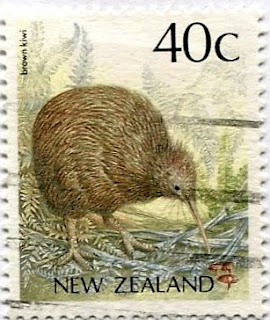
1988: Native Birds
Travelling to New Zealand here is their unique native bird.  The kiwi is not the only flightless bird on New Zealand in fact there are 16 species which includes
Definitive series issued over a four year period 1985-89 - Native Birds (Design: Janet Marshall)
the world's only flightless and nocturnal parrot, the Kakopo.  The Blue Duck can definitely fly but is reluctant to do so and lives by fast flowing mountain streams, nesting in hollow logs and caves.   The designer of the Native Birds stamps is Janet Marshall who writes she has been painting New Zealand birds and flowers since 1970

Luckily for the ground dwelling birds there are no fast running cheetah in New Zealand
1973-86: Definitive (New Currency)
like this pair scanning the horizon in Yankari Game Reserve, Nigeria's largest National Park 866 sq miles (2,244 sq k) in North East Nigeria.  This was the first definitive set issued after Nigeria switched from Sterling to the new currency of Naira and Kobo. 

Lastly I return to New Zealand for some inanimate objects
1982: Definitives - Minerals
and the minerals found there which featured on the 1982 definitives. Here are some I might like to wear, the first nephrite, one of the two minerals commonly called jade although nephrite can be found in other colours apart from green and amethyst which comes in a range of variable intensity.


Sunday Stamps II prompt this week is the letter N - for Norway, Newfoundland New Zealand, Nigeria, Northern Lights, Nephrite, Native Birds and Animals and National Park - nip over to See It On A Postcard.


Sunday, 6 September 2015

Underground Overground

For this week's Sunday Stamps theme I'm going with the mining aspect mainly because I think I've shown most of my mineral stamps before.  Where better to start than South Africa who over the years have issued a lot on this theme, although I only have some early examples such as this definitive stamp from the 1930s of a Gold Mine.
Here comes the next process of heating and pouring the gold. If the tourist heads to Gold Reef City, Johannesburg you can take a ride on a miniature railway, and go underground to see the gold and then watch a gold pour.  Not sure that it will be on the same scale as that shown on the stamp.   South African mines hold 50% of the world's gold reserves but of course the other thing the country is famous for is
diamonds and one makes an appearance on the 1965 set for the 5th Anniversary of the Republic

1986: Rock Formations
But lets head for the light and journey above ground amongst the granite of the Paarl Mountains in the Western Cape, their name means pearl rock. 
Staying in Africa here are the tin mines of Nigeria.  When this definitive stamp was first issued in 1953 that was the year the country exported 11,942 tons of tin and earned £8.55M but with fluctuating tin prices and the discovery of oil today it is a past industry.  There is still informal mining by the locals who dig holes in the ground to access the tin but it can be a dangerous business with collapsing tunnels.  In the olden days they used to call these type of people prospectors which is where the next Australian stamp comes in
and the Broken Hill Silver Mine first prospected in 1883, the reason for its name no longer exists the hill having been mined away.  The aborigines name for the hills was the more romantic Leaping Crest.  Broken Hill (nickname Silver City) is located in the outback of New South Wales and is Australia's longest lived mining city although mining is no longer the main industry it contains the world's largest silver-lead-zinc deposits.
1955: Five Year Plan
In China here is some sort of underground machinery grinding its way along a tunnel and lastly
1954: Industrial Development
is how it all might start with the geological survey team arriving at a rock face. 

An entry to Sunday Stamps II theme of - Rocks, Gems and Minerals - discover more here