Sometimes a year takes on an unintentional theme and this one for me has been maritime paintings which started earlier this year with a visit to the National Maritime Museum's stunning exhibition "Turner and the Sea" and may have ended with the most recent trip to a smaller but interesting Harris Museum's current exhibition "Making Waves" so contrariwise I'm about to go on holiday nowhere near the sea.
The ship with full sails speeding through the waves is the Sigyn built in Göteborg (1887) and one of the last sailing barques built for worldwide trade before steam took over (Wikipedia ship history here) Considered fast and beautiful the Sigyn is now a museum ship moored in Turku on the south west coast of Finland.
The artist is Håkan Sjöström,, born in 1937 many years after this ship first set sail but he would have lots of opportunities to study the Sigyn as he worked at a shipyard in Turku until his retirement and is considered the foremost marine painter in Scandinavia. He has painted ships from many eras and also produced paintings for Åland Post's six year series on passenger ferries which concluded earlier this year. Appropriately one of the last stamps included a ship built by a Turku shipbuilder, the STX-shipyard (FDC here). Not as romantic as a sailing ship but to arrive by sea is always a wonderful way to arrive in a place or country.
Saturday, 16 August 2014
Sunday, 10 August 2014
The Deep
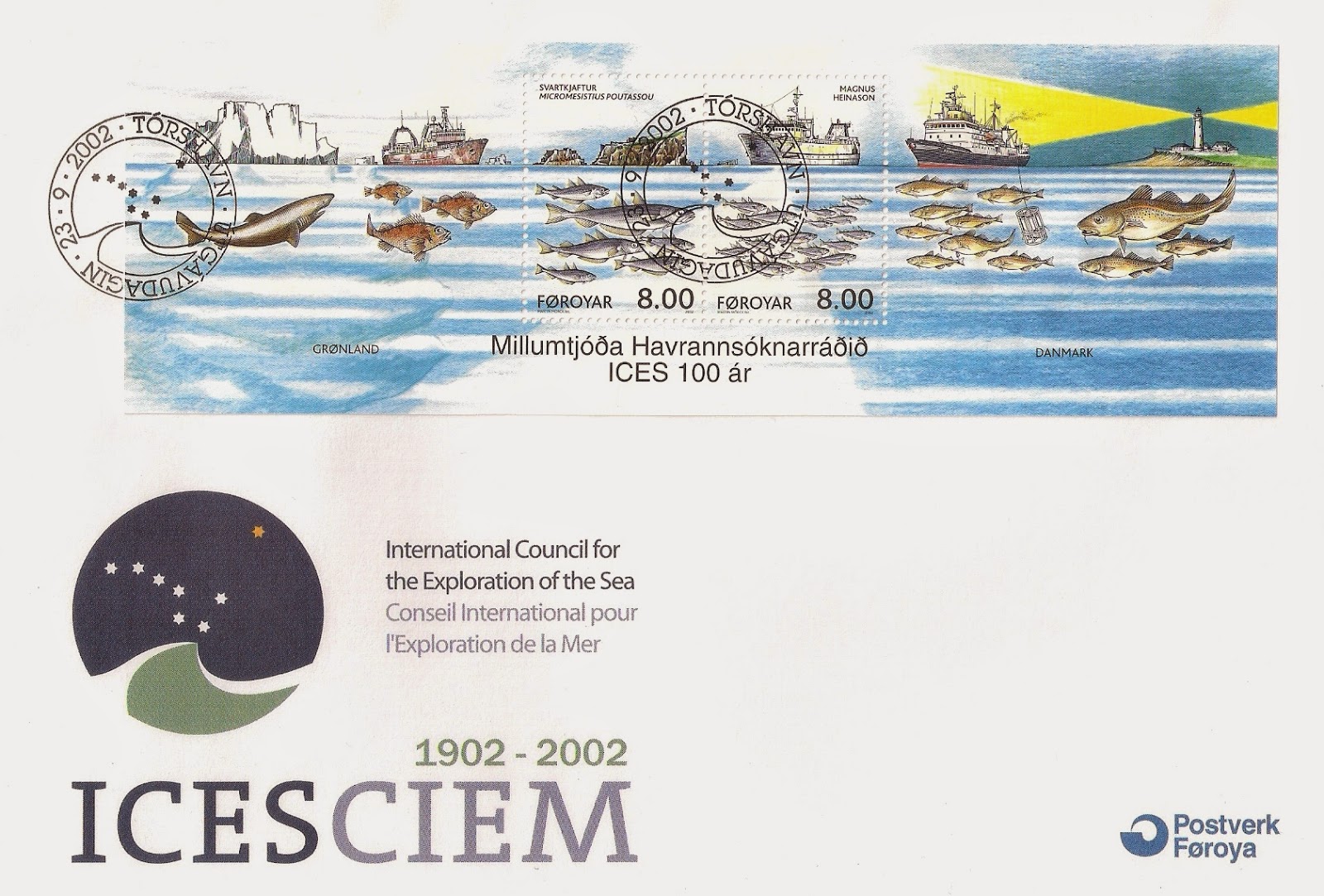
The International Council for the Exploration of the Sea (ICES) is the world's oldest scientific intergovernmental organisation and its objective is the sustainable use of the oceans and increase of scientific knowledge. Founded in 1902 to study and advise on marine science in the Atlantic, Baltic and North Sea, it now includes the Arctic in its remit. Three countries of the founding members of ICES commemorated its 100 years by jointly issuing the same miniature sheet but each taking two different sections to make the whole scene.
The Faroe Islands two stamps appear in the middle of the miniature sheet. On the left - Blue Whiting (a member of the cod family) who swim near the surface at night and migrate to the bottom during the day. The stamp on the right features Atlantic Cod and a marine research ship named after Magnus Heinason, a 16th Century Faroese naval hero and privateer. The ship's home port is Torshavn and at the moment it is at sea just to the north of the Faroe Islands.
The Greenland section of the sheet on the left show a Greenland Shark and Deepwater Redfish. On the right is where Denmark's two stamps would appear and show Atlantic Cod with the rays of the Hirtshals lighthouse and the marine research ship Dana whose home port is the town of Hirtshals on the Jutland peninsula. Curious to know where it is at the moment? Looking on the Marine Traffic site it seems to be slap bang in the middle of the North Sea in-between North East England and Denmark.
ICES requests countries to reduce or stop fish catches for certain species based on its research and statistics, whether they do so is another matter. Spain issued a "Marine Species in Danger of Extinction" in 2013 featuring species on the edge
Top left - Basque Whale who live in shallow coastal waters and in the summer move to the colder water of the North Atlantic.
Top right - Bluefin Tuna, native to the Atlantic and Mediterranean and whose numbers have been decimated by overfishing
Bottom left - Monk Seal, lives in the Mediterranean and at great risk of extinction. The world would be a poorer place without the chance of seeing a seal.
Bottom right - Sea Lamprey - an anadromous species like the salmon which spawns in rivers and migrates to the sea. It did freak me out as a child when I saw a picture of its suction cup mouth and the result of it attaching to skin and rasping away at tissue with its sharp tongue and teeth. I have since seen one in reality coiling out of a rock but happily there was a sheet of glass between us and it looked rather languid.
I will finish with the more curious sea creatures on Albania's 1968 Marine Fauna series
The Faroe Islands two stamps appear in the middle of the miniature sheet. On the left - Blue Whiting (a member of the cod family) who swim near the surface at night and migrate to the bottom during the day. The stamp on the right features Atlantic Cod and a marine research ship named after Magnus Heinason, a 16th Century Faroese naval hero and privateer. The ship's home port is Torshavn and at the moment it is at sea just to the north of the Faroe Islands.
The Greenland section of the sheet on the left show a Greenland Shark and Deepwater Redfish. On the right is where Denmark's two stamps would appear and show Atlantic Cod with the rays of the Hirtshals lighthouse and the marine research ship Dana whose home port is the town of Hirtshals on the Jutland peninsula. Curious to know where it is at the moment? Looking on the Marine Traffic site it seems to be slap bang in the middle of the North Sea in-between North East England and Denmark.
ICES requests countries to reduce or stop fish catches for certain species based on its research and statistics, whether they do so is another matter. Spain issued a "Marine Species in Danger of Extinction" in 2013 featuring species on the edge
Top left - Basque Whale who live in shallow coastal waters and in the summer move to the colder water of the North Atlantic.
Top right - Bluefin Tuna, native to the Atlantic and Mediterranean and whose numbers have been decimated by overfishing
Bottom left - Monk Seal, lives in the Mediterranean and at great risk of extinction. The world would be a poorer place without the chance of seeing a seal.
Bottom right - Sea Lamprey - an anadromous species like the salmon which spawns in rivers and migrates to the sea. It did freak me out as a child when I saw a picture of its suction cup mouth and the result of it attaching to skin and rasping away at tissue with its sharp tongue and teeth. I have since seen one in reality coiling out of a rock but happily there was a sheet of glass between us and it looked rather languid.
I will finish with the more curious sea creatures on Albania's 1968 Marine Fauna series
the Squid, Lobster and Northern Whelk
Spiny Lobster and Green Crab
An entry to Viridian Postcard's Sunday Stamps theme of - Undersea Life here
Sunday, 3 August 2014
Idyll
![]() | |||||
| 1969 Paintings in the National Gallery, Budapest ('"Black Pigs") |
one of the China definitives of the 1980s featuring the scenery of China. These are the palm trees of Hainan, a tropical island in the South China Sea which has no winter although in January and February the cold winter air from the north comes into contact with the warm sea causing continual fog and creating extreme moisture in the air. The island is a popular tourist destination and one of its big events is the Coconut Festival in late March and early April and for the local Li people March is also the time associated with love when traditionally weddings takes place,
I have shown a couple of my Chinese prepaid postcard of 'Landscapes of Guilin' before and this week's Sunday Stamps theme gives me an excuse to show another one.
![]() | ||
| Nine Horse Fresco Hill |
An entry to Viridian Postcard's Sunday Stamps theme of - Faraway Places
Sunday, 20 July 2014
Painting the World
![]() |
| 2002: Birth Centenary Albert Namatjira |
He would go on to produce about 2000 paintings which he would always paint plein air on his many walkabouts with his family but only in the winter or dry season due to the famously severe Australian sun in the summer. The ochre tones not only represent the landscape in western artist style but also are influenced by Aboriginal tradition. These were not easy times for the indigenous population as the aboriginal people lived under restrictive legislation that made them wards of state and were not given Australian citizenship until 1968 (Namatjira died in 1959) but Namatjira would become the first named Australian aborigine to have his portrait appear on a postage stamp. The Hermannsburg School of Artists website shows how Albert was the first of many indigenous artists who would portray their love of the landscape in this way here.
Someone else who was always travelling (but in Europe) and painted landscape watercolours was Edward Lear but he is probably better know for his illustrations and verse
![]() |
| 1988: Death Centenary of Edward Lear |
Sunday, 13 July 2014
Shangrila
![]() |
| 2010: Shangrila |
"The crystal glacier extreme from the peak all the way to the forest area an altitude of 2700 metres which forms the most spectacular low latitude monsoonal oceanic glacier in the world. A streak of scarlet light pierced the dark clouds, revealing over 50 steep snowcapped summits, shining, dazzling and thrusting into the clouds like golden swords"
![]() | ||
| 2004: "Frontier Scenes of China" |
12.1 - Forest of Xing'an Mountain
12.2 - Lake in the Yalu River Basin
12.3 - Reefs in the Yellow Sea
12.4 - Zhoushan Archipelago
12.5 - The coastline of Taiwan
12.6 - Xisha Islands
12.7 - Karst Landscape in Southern Yunnan
12.8 - Rain Forest in Southern Yunnan
12.9 - Mount Qomolangma
12.10 - The Pamirs
12.11 - The Badain Jaran Desert
12.12 - Hulun Buir Steppe
An entry to Viridian Postcard's Sunday Stamps theme of - "Beautiful Landscapes" here
Friday, 11 July 2014
Eco Museum
I love an old fashioned (in the best possible way) museum that is just full of 'stuff' and the Ecomusee de Lizio in Brittany fits the bill perfectly. The founder, Alain Guillard, saw old objects and tools disappearing and being lost forever and started to collect and restore them; this treasure trove of 100,000 tools and objects is the result. Breton house interiors, workshops and schools are lovingly displayed, this postcard shows a selection on the theme of transport. Bottom right are toys of the Tour de France being held up at a railway crossing whereas the old Citroen, top left, I always think of as the 'Maigret' car. Looks like we are all off on holiday, top right, and hopefully will not need the services of the breakdown truck (bottom left).
A short Q and A with Alain Guillard and directions to the Eco-museum of old trades and occupations here
Friday, 4 July 2014
Postie
Heading to Yorkshire to see the Tour de France so what is more appropriate than a picture of a postie on his steed spotted last time I was in York in 2013, coincidently also in the month of July. By chance I also discovered on last year's trip the York Central Delivery Office which is on Leeman Road down by the side of the River Ouse and took photographs of the extensive bike stores but alas the sun's direction and the security railings conspired against me as can be seen
Subscribe to:
Posts (Atom)