Showing posts with label History. Show all posts

Thursday, 1 October 2026

Echoes of History

 See It On A Postcard's Thursday Postcard Hunt - in search of UNECO sites

The Grand Palace of Knossos was built around 1900 BC, rebuilt after an earthquake in about 1700 BC and finally destroyed around 1375-1400 BC.  It was the cultural and political centre of the Minoan civilization on Crete. The site was inscribed on the UNESCO World Heritage list of 'Minoan Palatial Centres' in 2005.

The card shows the watch room or guardhouse of the Palace, an entry area to the west wing complex. 


Roman Wall at Housesteads Mile Castle. (Northumberland)

 Hadrian's Wall stretches across the narrowest part of northern Britain, spanning 73 modern miles (80 Roman miles). Built on the orders of the Roman Emperor Hadrian in AD122 as the northernmost limit of the Roman Empire and to control border crossings. The guard posts or mile castles were about 55 square feet and garrisoned by 50 men. They were built at mile intervals, with larger forts for 1000 infantrymen occurring at intervals of 3 to 7 miles.

Inscribed by UNESCO in 1987 as a standalone site and then extended in 2005 and 2008 into the transnational 'Frontiers of the Roman Empire' (which includes the Antonine Wall in Scotland and the German Limes (Limes Germanicus) fortifications.

Sunday, 20 September 2026

Island History


1981: Discovery of Madeira
Portuguese explorers were blown off course while sailing along the West African coast, after many days adrift they found a small island harbour which they named Porto Santo. Much later the sailors noticed a heavy dark bank of clouds to the south west of this small isle and sailed towards it in 1419 and found a densely forested island they named Madeira (meaning 'wood' in Portuguese).
1993: The Red Cross and Scout Movement
70 years of the Red Cross in 1992. The stamp shows the Greenland flag, a rising sun. Also 50 Years of the Scout Movement in 1993 with two scouts gazing out of their tent. Musk Ox also make an appearance on this sheet, perfectly clothed for the Greenlandic climate, they are known there as Umimmak - the long-bearded one.
1986: Bicentenary of Reykjavik

The first official seal of Reykjavik, introduced in 1815, featured a fisherman, a boat and a flatfish. It was replaced in 1957 by the current logo, a blue shield design

Sunday Stamp theme - Historical Events - See It On A Postcard 

Thursday, 30 July 2026

Shelters

 See It On a Postcard's Thursday Postcard Hunt - Shelters

Charcoal Burning
A charcoal burners hut. A charcoal burn requires constant day and night supervision to watch the smoke colour and seal any cracks in the earth mound and control the air flow. The huts are simple structures consisting of a stone base, wooden poles, turf and branches.  At the height of the industrial revolution there must have been hundreds. The remains can still be seen in the woods today, here is an example.
Barn in Winter. (2016: Finnish Barns Maximum Card 112)

 I presume this what the Finns call a Lato (Hay Barn). A good thing to take shelter in if you were caught in a snow storm.

But let our thoughts turn to summer and the 3-12 August 1951 Scout Jamboree in Bad Jschl, Austria. This card has both a hut and tents. The card comes with a
postmark and a scouts message home as he sets out in that direction. It says "At the moment I am not sure who is going to wait for who at Dieppe but I believe it is equal. Otherwise alive and I am not broke yet. Today it is sun again"

Sunday, 26 April 2026

Majestic


1965: Birds

Its that time of year when ones mind turns to holidays. Perhaps a trip to Malaysia where the locals might point out a Murai Gajah (Asian Fairy Bluebird) on a tree.


1994: Malaysian Airlines inaugural flight cover

 Fly out of Malaysia to Buenos Aires to dance the tango under a moonlit Brazilian sky.  Where next? 

 
Travel back in time to the 1950s and the Hotel Majestic in Acapulco, Mexico
 
 
A sea view from their rooms
 
Definitive 1950s: Architecture and Archaeology 
 
Buy a Michoacan Mask as a memento although a lot of these dance masks look very scary.
 
 
Catch some sport at the Mexico City University Stadium. Built in 1952, at the time the largest stadium in Mexico. It is now called the Olympic Stadium after hosting the 1968 Summer Olympics
1969: Tourism
Enjoy visiting the Pyramids in the ancient city of Teotihuacan (place of the gods).  Not built by the Aztecs or Mayans but an ancient race, origins unknown.
  
Sunday Stamps A-Z for Mexico, Malaysia and Majestic - See It On A Postcard 

Sunday, 11 January 2026

X


1977: Birds
This woodpecker is so unique it decided that it would rather appear at X than W. It is the only species within the genus Xiphidiopicus.  The bird's full Latin name is Xiphidiopicus percussus or Cuban Green Woodpecker. The most widespread and common woodpecker in Cuba, endemic to the island.
1990: 25th Anniversary of the Oceanological  Institute
Cuba is fond of Roman Numerals on their stamps
1930: King Christian X -  60th Birthday
and monarchs like them too.
1970: Bulgarian History
Another king. Cyrillic has an X but with a sound as the ch in the Scottish loch. On the stamp Khan Asparerch and the 'Old Bulgars' are crossing the Danube. An x appears at at the beginning of his title XAH  (Khan) and the end of his name.

2012: United Kingdom  A-Z Part 2

The stand alone X of Station X, Bletchley Park home of the code-breakers who among other things broke the Nazi Enigma code, the result of which it is said cut the length of World War II by an estimated 2 years.

Sunday Stamps A-Z this week has reached X - See It On A Postcard 

Thursday, 8 January 2026

Reflections

 See It On A Postcard's Thursday Postcard Hunt for Light and Reflections...


A serene swan swims over the still water of Ulverston Canal basin.


On the shifting tidal sands of Morecambe Bay early in the 20th century. The cocklers are softening the sands by rocking their jumbos which bring the cockles to the surface. The process would be the same today but it is no longer a main source of income for anyone. There would not be a large family group and of course instead of a horse and cart there would be a tractor or quad bike. When one is a mile out the local knowledge of tides, the continual changes in the channels and quicksand just as important today as in past centuries.

In contrast here is a city that looks as though it is floating between two worlds.  Joensuu is the regional capital of North Karelia in Finnish Lakeland. The city is on the shores of two lakes and at the mouth of the river Pielinen. 

Thursday, 25 September 2025

Scenes from History

 See It On A Postcard's Thursday Postcard Hunt is looking at History

Der Rütlischwur (The Rütli Oath) - by Ernst Stuckelberg

One of the murals in William Tell's Chapel by Lake Lucerene tells the story of the Rutli Oath which was taken at the foundation of the Old Swiss Confederacy by the three founding cantons. It is named after the site of the oath, the Rütli, a meadow above the lake. 

The Greek War of Independence from Ottoman rule. The city of Missolonghi was one of the first to rise against the Turks in 1821. Trying to get the city back the sultan sent troops to suppress the revolution, which failed. He sent a larger force in 1825 and a siege of the city began, lasting a year. The Greeks could not get food through the Turkish encirclement and people started dying. Eventually the citizens decided to secretly leave the city on the night of 10th April 1826 but their plan was betrayed and when they opened the gates in the middle of the night the Turks attacked killing all the women and children and most of the soldiers.   (The stamp is  a painting entitled 'Flight from Missolonghi' from the 1982 Europa theme of Historic Events)
A view that spans the centuries in Rome, not a chariot in sight but there are some cute 20th century cars. The Pyramid of Cestius, built outside the city walls in 18-12 BC as a tomb for Gaius Cestius stands between two ancient roads.  The entrance at that time was named Porta Osttiensis after one  of the roads.  The famous entrance shown on the card was built in the 3rd Century and is known as Porta San Paulo This is the gate the Ostrogoth entered breaking the Siege of Rome 549-50 and sacking the city. They were let in by hungry and disillusioned guards who believed the promises of the Ostrogoth that they would not be harmed. 

Sunday, 21 September 2025

Hot Air Balloons


1997: For Us Children
The ultimate air mail arriving by the power of hot air.

1983: Bicentenary of Manned Flight

Left: - In 1859 John Wise carried 123 letters in his hot air balloon 'Jupiter', the first official airmail delivery for the US Post Office. Right: - The pioneering flights of  balloons during the Siege of Paris of which the The Neptune was the first to take off in 1870. Weight was of great importance because every balloon had to reach the altitude of at least 3,300 ft (1000m) in order to be beyond the range of the Prussian rifles. Neptune took off from the hill at Montmartre with three bags of mail weighing a total of 125g, and eventually landed in the grounds of Castle Cracouille at Evreux, 104 miles NW of Paris.
1983: Bicentenary of Manned Flight

  
Hungarian Hot Air Balloons for leisure. The captive observation balloon at the Budapest Exhibition in 1896 and the 1904 Balloon Chase Race. Balloon racing became quite popular at this time unfortunately I could only find a passing reference to Hungarian races but this paragraph of British events in 1904 gives the gist of the pursuit.
1989: International Young Inventors Exhibition, Plovdiv 

Bright young minds travelling to Plovdiv, the tiger arrives by hot air balloon.

Sunday Stamps A-Z, this week it is H for Hungary and Hot Air Balloons - See It On A Postcard

Sunday, 3 August 2025

Australia Day

 A is for Australia Day -

1990: Australia Day (Illustrator - Celia Rosser)
The Golden Wattle acacia was pronounced Australia's floral emblem in 1988. The adoption of the wattle dates back to 1899 and indeed there is a National Wattle Day on the 1st September when acacia of all species are in flower. Australia Day on the other hand is celebrated on the 17th January.
1982: Australia Day (Design and Engraving - Brian Clinton)
Brian Clinton has been a prolific designer of Australian stamps since 1977 but has a passion for portrait painting so he would have enjoyed this postage stamp commission.
1966: Famous Navigators (Design - Walter Jardine)
Adventurers - Two famous seafarers exploring the southern oceans, Captain James Cook and Abel Tasman. The cancel extols the virtues of  Australian food products - "Australian Food Produces Champions".
1953: Food Production (Design - George Lissenden)
Agriculture - Australia's biggest grain crop is Wheat.
1982: Reptiles and Frogs (Design - Beverley Bruen)
Amphibians - Corroboree Frog found in New South Wales. Pretty but poisonous. The poison is secreted from their skin to protect against predators, useful as they are ground dwelling
2003: Nature of Australia - Rainforests (Design - Wayne Rankin)

Sometimes it is safer in a tree. The orange-thighed tree frog in the wet tropical rainforest of North Queensland - Daintree National Park
1982: Tourism - Surf Boat
Aerogrammes -  One can fit a lot of correspondence, indeed a whole life, in this inexpensive, thin, lightweight folded piece of postal paper. The UK discontinued their use in 2012 but having checked on the Australia Post site they still issue them. The current one features flora and fauna of Australia.

Sunday Stamps is starting on a journey through the alphabet - See It On A Postcard 

Sunday, 30 March 2025

Military Siege


1993: 350th Anniversary of the Siege of Castle Cornet (Design - Clive Abbott)
Scenes from the English Civil War. Castle Cornet was a Royalist stronghold however the population of Guernsey were for the Parliamentarians, they called on the Lieutenant Governor to surrender but he fired on them.  The population were not equipped to storm the castle as they discovered after one abortive attempt. The defensive batteries around St Peters Port originally built to protect Guernsey from the French directed their fire at Castle Cornet.  The guns on the castle fired back. Today archaeological excavations regularly find musket and canon balls fired from the castle.  Cornet was supplied by ships throughout the Civil War which were sent by the Lieutenant General of Jersey.  I liked the story portrayed on the 28p stamp of the three local officials who were tricked aboard one of the enemy ships thinking it was one of their own but the captain had switched sides. Imprisoned for 43 days they managed to escape by making a hole in the wooden floor to the room below where they found a supply of flax which they made into ropes and escaped.

The FDC shows the three shields of Castle Cornet's commanders, Osborn was disliked by both the population and his own side however on surrender Burgess, the last Governor, and his men, were allowed to march out bearing arms and leave the island at the end of the siege in recognition of their humane treatment of prisoners. Here is the story from the FDC insert...
taking us to the present day...

 Sunday Stamps theme - Military - See It On A Postcard

Thursday, 6 March 2025

Women Mostly Sitting

 See It On A Postcard's Thursday Postcard Hunt for Woman at Work

2013: Europa - The Postman's Van
Postie at work in Ilulissat, West Greenland, some lucky person is getting a parcel.  This article on covers from Greenland's philatelic postal centres has a photo taken from where the post van is parked.

This looks like a production line for the popular Dinky toys, made by Meccano, today highly collectable.  The company also  produced mechanical construction and Hornby train sets.  After numerous take overs the Liverpool factory closed in 1979.  Today different kinds of Meccano sets are made in France and China.
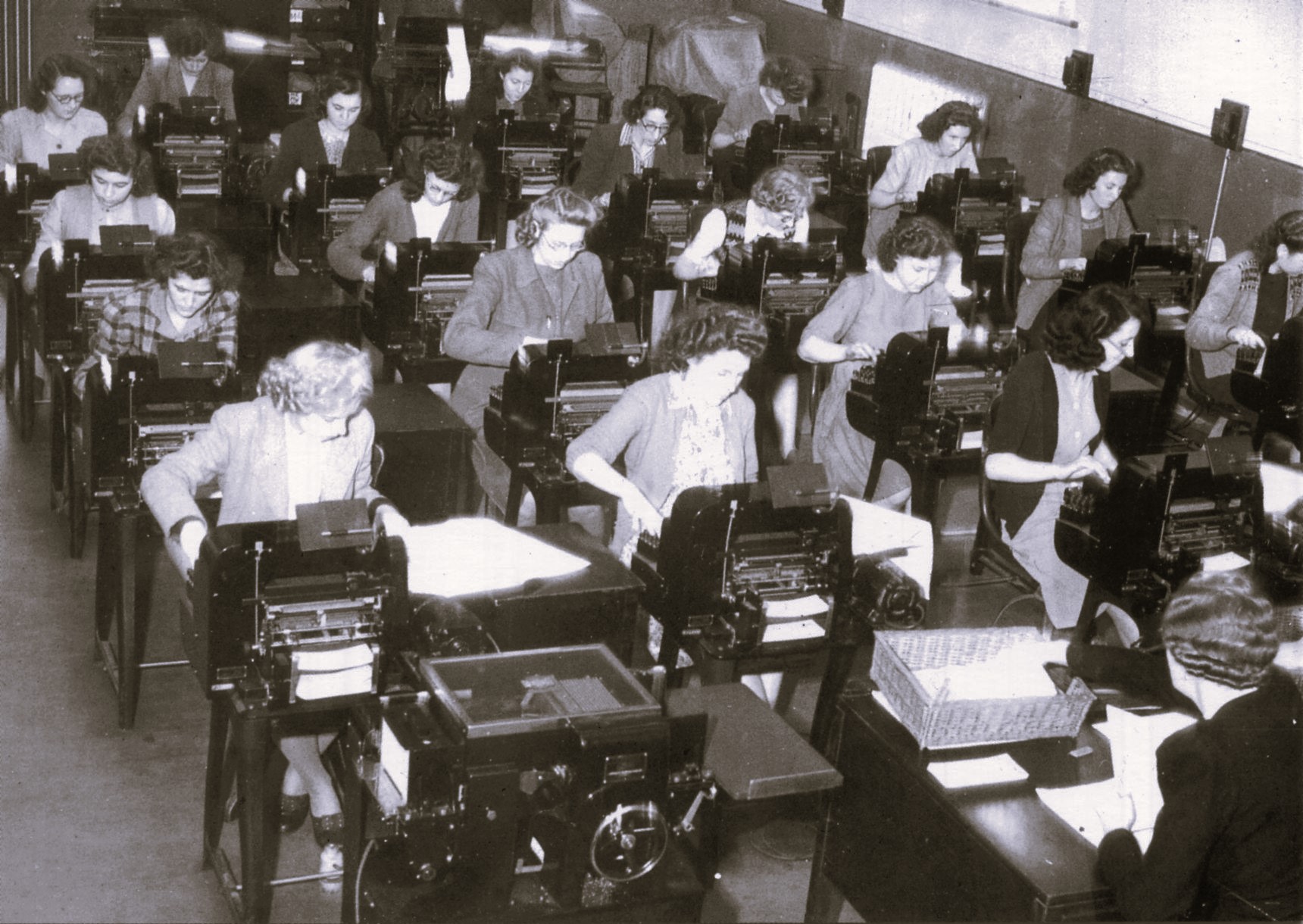
Female workers using comptometers, Vickers Armstong, 1950s
A human computer, workers using comptometers, the first key driven machine for adding and calculations. High speeds were attained by skilled operators.  Vickers Armstrong, an engineering, shipbuilding and armaments company, after many changes today operates as BAE Systems, the UK's largest manufacturer.

Thursday, 9 January 2025

Green Sward

 See It On A Postcard's Thursday Postcard Hunt is in search of the colour green

The Cricket Game by David Inshaw

In the middle of winter it is time to dream of the warmth and light of summer and the sound of ball on willow of a cricket match underway.
I wonder what games the Roman soldiers played here to while away the time at Hardknott Fort which guarded the Hardknott and Wrynose Passes at this isolated spot, protecting the supply chain that ran from what was then the port of Ravenglass inland. Today the passes 1 in 3 gradient and twisty narrow single track still make it a bit iffy in winter in fact they were shut at the weekend due to snow and icy conditions causing a multi car pile up.
 
Eden Valley - 1960s Railway Poster - Artist A J Wilson
Perhaps the time of year to be in the pastures by the Eden River (know to the Romans as Itouna, meaning rushing water)
2010: Endangered Species - Mammals

I think this water vole would agree.


Sunday, 10 November 2024

Rememberance Sunday


2008: The 90 Years of Remembrance - Lest We Forget
The mini sheet shows the wreaths on the Cenotaph in London which, the national point of remembrance. The stamp shows the Isle of Man's National War Memorial in the village of St John's whose wreath laying ceremony is this afternoon followed by a service of remembrance at the Royal Chapel.
2015: Stories from the Great War (Design - Charlotte Barnes)
The confident "Home by Christmas" was said of the troops at the outbreak of World War One in 1914.  Philip Carré the postman on the island of Sark joined the Royal Guernsey Light Infantry and would return in 1919 when the regiment was demobilized. He would send more than one Christmas card.

The bottom stamp shows the postmen from the Bailiwick of Guernsey who joined the Post Office Rifles, originally a volunteer territorial unit.  That changed at the outbreak of the World War in 1914 when they were called up to serve abroad.  Lawrence Burridge was killed in May 1916, age 23 and Albert Smith died from gunshot wounds in December 1917, age 25. The other three, Privates JG Fowler, AW Smith and HF Taylor's fate is unknown, lets hope they made it home.  I think the reason for the uncertainty is that half the British army's service records were destroyed in 1940 when a German bombing raid struck the War Office in London.

Sunday Stamps theme - Military - See It On A Postcard