Showing posts with label Estonia. Show all posts

Thursday, 22 May 2025

Home Sweet Home

See It On A Postcard's  Thursday Postcard Hunt is looking at colourful buildings

The Kadriorg Palace in Estonia, built for Peter the Great in 1718 but after his death as my sender says it "fell to bad times... but a century later its situation changed and the Russian royals started to use it during the summer". When the daughters of Tsar Nicholas I visited in 1832 an illuminated road connecting the palace and the beach, a boat landing, and a bathhouse were built for the occasion.

A more humble abode in suburban Melbourne resplendent in sunshine yellow. The Maxi Card celebrates the art of Howard Arkley (1951-1999)  who was fascinated by the colourful postwar suburbs of Australia.
2003: Australian Paintings
This one even has a lovely patterned wall.

Sunday, 18 March 2018

Its Electric

1991: Scientific Achievements (22p Design - Peter Till)
Michael Faraday appears in this stamp buzzing with ideas and what looks like one of those Faraday wheels we all enjoyed spinning at school to see how electricity worked. Faraday, explorer of electromagnetic fields and inventor of the electric motor was one of four scientists to be celebrated in this set of stamps.
2011: Green Initiatives
Today we try to save electricity with energy efficient light bulbs.  Due to Heleen's broken computer I am missing the weekly learning Dutch through stamps, as I am sure we all are, this light bulb has some Dutch words within it - 'Europa geeft groen licht'  Europe gives green light,
1956: Waterfalls and Power Stations
Going back in time this stamp set showed both waterfalls and power stations and from the date 1921 at the top of the stamp I think this particular one is  the Ellidaár Power Plant, Iceland's first hydroelectric power plant which today forms part of an Electrical Museum.  Lets now travel to China to see one of their hydroelectric power stations
1964: Hsinankiang Hydro Electric Power Station (Designer - Wu Jiankun)
being built, the Xinanjiang or Hsinankiang (depending how it is transliterated into English) Hydro-power station and its dam under construction and then the installation of a turbo generator rotor
followed by the completion of the project in a rather idyllic looking location.  I haven't got the last stamp in the set which shows the pylons in a more 'dark satanic mills' setting.
1974: 25th Anniversary of Technical and Scientific Cooperation between Hungary and Soviet Union
rather like this combinations of Hungarian power installations but pylons similar to these might be providing power for
2012: Baltic Railway Bridges
electric powered trains
1995: Trams
and trams.  These trams used to run in Sweden's northernmost town Kiruna which lies inside the Arctic Circle.  There used to be three tram lines which existed from 1907-1958. Kiruna is a mining town so the first line to be built was the mountain line which saved the miners a cold walk of several kilometres  and a climb up the mining hill.
I think this snowy Maximum card may show the mountain route which closed in 1955 after a road was built to the mine. The other line was the city tram line which had 8 Km of track and was unusual in that it had a 1 metre gauge, the carriages had double windows and heating. This closed in 1958 when buses took over from trams.  Lastly between 1941 and 1964 a tram line was used inside the mine with wagons  acquired from the closed down tram lines all over Sweden.  Kiruna is in the news at the moment because due to mining subsidence in the centre the town is being moved 2 miles to the east which led one newspaper calling it 'the centipede town'.


An entry to Sunday Stamps II prompt of the Letter E - for Electricity, Energy, Elidaár and Estonia - See It On A Postcard.    


Sunday, 25 February 2018

Briliant Birds

A cover celebrating the 700th anniversary of Biberstein (1280-1980) a village in Switzerland which lies on the north bank of the Aar River. Perhaps one might spot a kingfisher here, if not then there are kingfisher stamps. The village's castle was built in 1280 and features on the cancel as does its coat of arms - a beaver.  This is a play on words which I believe in heraldry is called 'canting' a visual pun on the bearers name and in this case the beaver (in German 'biber) is sitting on a stone (German 'stein') and so we have Biberstein
1966: Int Congress for Conservation 'Pro Natura' Lucerne (Design: B Waltenspühl)
This post may mostly feature birds but now one beaver has appeared why not have another one
1982: Landscapes and Animals
this time living near Lake Hovd in Mongolia.  Lets now return to Europe and Bulgaria for more brightly coloured birds
1965: Songbirds
and ones known for their songs.  From left to right, Northern Bullfinch, Golden Oriel and Rock Thrush
2000-2009 Definitives (Design - Chris van Rooyen)
Of course for vivid plumage the place to be is Africa and here is the Lilac Breasted Roller, one of the many birds that appeared on South Africa's 7th Definite Series along with fish, butterflies and flowers. For some reason none of the butterfly stamps have turned up with me. 
The Woodland Kingfisher perches on the definitive stamp and may not look as brilliant in colour as the common kingfisher but once it unfurls those wings it dazzles.  
2014: Bird of the Year (Design - Vladimir Taiger)
The Common or Eurasian Kingfisher was chosen as Bird of the Year for Estonia's continuing series of stamps. Every year since 1995 the Estonian Ornithological Society has chosen the bird of the year which is linked to other events such as mapping localities and trying to get a better estimate of numbers.
Most of Estonia's kingfishers are found in the south and despite it being a small country there are over 7000 rivers and brooks and 1,500 lakes, perfect for kingfishers if it were not for the very cold winters.


Sunday Stamps II prompt of the Letter B - for Birds, Beavers, Biberstein and Bulgaria - See It On A Postcard
 

Sunday, 1 October 2017

Icy Lands

1957: Glaciers
Oraefajökull is an ice covered volcano in south east Iceland of 6870 ft (2110m) whose height varies with the seasons with Spring being the time the ice is at its thickest and it is at its highest.  The area is a national park and popular skiing and climbing area.
1972: Herðubreið
Another volcano but this time a flat topped one which are called tuya. Herðubreið in the highlands of Iceland is considered the most beautiful mountain by Icelanders but because of its steep and unstable sides its first ascent was only in 1908.
1986: Europa - Protection of Nature
The Skaftafell National Park whose landscape has been compared to the Alps but of course its geology is very different. It is popular for it is an area of sunny days and I quote "an agreeable climate" and more importantly "a breathtaking collection of peaks and glaciers", waterfalls, rivers and birch woods.

I thought I would have more Iceland stamps featuring ice but there were not as many as I expected however some icy peaks came from an unexpected direction
1975: 5th Series of Definitive Stamps 1974-76
with this Indian stamp featuring the Himalayas.  But lets head to the high seas

2013: 50 Years of Tarmo
and the ships that keep them open in the icy north. Estonia celebrated the Tarmo reaching 50 with this stamp and a Maximum Card.  Built in Finland by Wärtsillä in 1963 it served under the Finnish flag until Estonia acquired it in 1993 when it was the only icebreaker in Estonia. The quote on the front of the card is from Lennart Meri, writer, filmmaker and politician who served as the 2nd president of Estonia in 1993 and seems to translate as "Breaking the ice and sea lanes for the ships and the states of Europe. Take care every Estonian sailor will be proud to act: Farmo!"
I rather like the linking chains cancel. Estonia bought another icebreaker in 2012 so now both the Botnica and Tarno keep the sea lanes open.

We don't need icebreakers in the Irish Sea and indeed if the sea freezes it only does so at the edges and on those rare occasions everybody goes out to have a look at it. 
2012: Christmas Scenes. A Time Gone By
I wonder what this winter will bring?  The artist of the Isle of Man stamp Michael Starkey "works from old black and white photographs of old buildings and streets that no longer exist and brings them back in colour with memories and research".  This set of stamps featured lots of snow and ice but of course my favourite includes a postie, van and postbox.


An entry to Sunday Stamps II this week's letter is I for - Iceland, Ice, India, Islands and Isle of Man -  See It On A Postcard   


Sunday, 3 September 2017

En Route

1974: 100th Anniversary UPU
Equatorial Guinea joined the Universal Postal Union in 1970, just in time to celebrate its 100th anniversary in 1974.  Their stamp set featured a romantic idea of carrying post with horses, canoes, llamas, sledges, mountain climbing and of course camels with a large 'correos' bag.
2013: Europa: The Postman's Van (Designer: Jaan Saar)
Estonia Post kept it real with horse power for the Europa theme of 2013.  The FDC features a 1960 mail lorry built by Tartu Utode Remondi, a company which operated from 1949-1997 in various guises. In 1960 it operated under the name Tartu Automobile Service Factory Number 3, nothing says Soviet more with a name like that.  The mail lorry seems to be based on the company's GAZ51, a 23 seater bus,  which they manufactured in various other guises such as bread lorries, and mobile workshops for people like hairdressers and shoemakers travelling around rural districts.
The stamps show a government stage coach dating from 1840 and one of today's modern vans. I think there is a piece of whimsy on the stamp as the titles seem to say old stage coach and modern stagecoach.  The span of time on the stamps would fit nicely into the existence the Estonian History Museum which celebrated its 150th Anniversary in 2014

I like the years rolling by on the stamp background.  The sword was found as part of some excavated grave goods and is dated to the 11th-12th Century. The stamp sheets have have little artifacts from the museum on the selvedges which I do not own but I have the next best thing
2014: 150th Anniversary of the Estonian History Museum
this FDC showing an entrance ticket from 1907 and a display of objects from the Estonian History Museum.  The designer is Lembit Lõhmusknown both for his work on many stamps and also engraved bookplates. His design of a silhouetted map of Estonia which features on the Estonian euro coin was chosen to be used after a popular vote in a national poll.  


Sunday Stamps II this week has arrived at the letter E - for Equatorial Guinea, Estonia and Europa - exit to See It On A Postcard.    

Sunday, 27 September 2015

Regional Costumes

A place of windmills, thatched houses and home made beer, ruled over in the past by Germany, Denmark, Sweden and Russia.  This is Estonia's largest island, Saaremaa. One of the 2013 Folk Costume set features the Karja who live in the north east of that island.  The Maximum card shows a young married woman wearing one of the typical hats of the area which can be of floral or geometric design.  The stamp itself
shows an elderly couple wearing the long coats originating in the 19th Century, the mittens are an essential part of the attire which are stuck in the belt when not keeping hands warm.  I imagine those mittens are an essential in a Baltic winter.

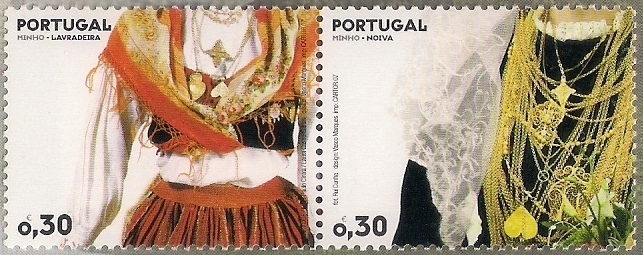
The next stamp shows the detail of a costume possibly most recognisably Portuguese on the left
2007: Regional Costumes
the bright colours of the Lavradeira  The elaborate embroidery and gold necklaces of the stamp on the right is the equivalent for a wedding.

Next we have costumes mostly associated with places of work starting

on the left with the Capa de Honras (Cloak of Honours) worn by cattle keepers and shepherds in the coldest months in the north of Portugal.  The next stamp is the Pauliteiro from the north east of the country worn by men performing a warrior dance to bagpipes. The origin of the skirt is unknown but some think it may have a Greek influence.  The embroidered ships on the next item give a clue to its origin for this is a Camisola de Pescador, a Fisherman's Shirt.  Lastly a most unusual item of clothing, the Cape of Reeds worn by shepherds (usually accompanied with a straw hat).

Heading to the seaside for the next stamp on the left

it is a costume from Nazare consists of seven skirts.  In the past the women would sit on the beach waiting for the men to return from fishing, perhaps they were counting the waves in skirt numbers (the seventh wave is always the largest). The red waistcoat on the next stamp is that of a campino, a horse backed cattle herder who manages and directs the cattle with long poles.  The next costume is from the Algarve camponesa (where there is a museum dedicated to regional costumes).  Lastly we have the Alentejo Capote, a winter coat which has a deep opening at the back to make it easier for horse riding.

An entry to Sunday Stamps II theme of - Folk or National Costumes - travel the world in costume here    
    

Sunday, 13 September 2015

Linking Bridges

Here is the Clifton Suspension bridge airily spanning the Avon river gorge in Bristol and one of the iconic bridges of Britain.  It was Isambard Kingdom Brunel's first major commission when he won the competition to design a bridge over the gorge at just 24 years old and he was appointed project engineer.  Construction was delayed for decades (1831-1864) and on his death in 1859 after a glorious engineering career it was felt by the Institute of Civil Engineers that the completion of the bridge would be a fitting tribute to their colleague.  Designed for pedestrians and horse drawn traffic the structure today carries traffic that Brunel would never have envisaged.   The cover celebrates its 150 years in 2014
with one of the bicentenary of the birth of Brunel stamps issued in 2006.  In fact this was a set I nearly went with this week as it includes three of his bridges but then I found this autumnal FDC which I thought was much more attractive and also so appropriate for the time of year. (The stamp shows a lithograph from 1834 of the bridge).  Now let us take a train trip
This set is called "The Baltic Railway Bridges" and was a joint issue between the three Baltic states. The Estonian cover features a black and white photo of the concrete Sindi rail and road bridge over the River Pärnu which opened , as they say "festively" in February 1928, the traffic regulated by a bridge guard.  I like the double header stream trains.  The cancel is of the Ahja Railway Bridge on the Tartu-Petseri Railway completed in 1931.  But lets look at the stamps left to right.
The first shows Estonia's Narva Bridge, the first built to span the river was in 1869, a stronger one had to be built next to it in 1902 but was destroyed in World War I. A new rail bridge, and the last iron bridge built in Estonia, was opened in December 1923 (162 metres) but destroyed in World War II as indeed was most of the city of Narva by either the Russians or the Germans. (I can't work out whether they have rebuilt this bridge or replaced it as all the photos I've found seem to show a different shape). However I am sure about the sparklingly new Swiss built Stadler FLIRT passenger train shown on the stamp which Estonia had ordered to replace their old trains and expected to be in use soon after the stamp issue but they eventually all came into service in 2013.
The middle stamp is Latvia's Carnikava Bridge, a metal bridge over the Gauja built in 1950 (220.8 metres). A rather nice picture showing it in context appears on Panoramio here
Lastly is Lithuania's longest and highest bridge, the Lyduvinai shown with an equally long goods train.   This stamp issue links three countries but the next stamp shows a bridge directly linking two countries
Liechtenstein with Switzerland ,and is part of the second issue of "Bridges Bring Together" featuring foot and cycle bridges. To journey between the two countries over the Rhine (which marks the border) at one time required a ferry and it was not until 1868 that a bridge was built but it burned down in 1894, the next wooden bridge built in 1896 collapsed with a fire. No wonder they turned to concrete for the present one.
The stamps and maximum cards show two view  of the Rhine Bridge
which links Bendern (Liechtenstein) and Haag (Switzerland).  Guess we are in high summer when the photo on the card was taken, which would be the ideal time to take a cycle ride.
Buchs to Schaan Bridge
This 132 metre bridge is a happy spin off from a large construction project and is the visible part of 6 kilometres of  an underground steam pipeline which brings process steam from a refuse incineration plant in Buchs (Switzerland) to industry in Liechtenstein.
Who would guess that from this peaceful view?. 

An entry to Sunday Stamps II theme - Bridges to Anywhere - cross over here to see more.           

Sunday, 23 August 2015

See the Light

2012: Norwegian Lighthouses III
The stillness of of a rolling mist coming in off the sea with perhaps the sound of fog horns and the gentle chime of buoys at sea is what these two stamps bring to mind.  The first is the wooden lighthouse near the harbour of Oslo by the whale shaped rock of Kvringen on the western seaward approach.  The island is now a protected nature reserve together with the surrounding area of shallow reefs. The tower dates from 1892.
A sunken rock in the middle of Oslo fjord is home to the 1876 Medfjordbåen light.  As might be imagined the Oslo fjord is Norway's busiest and the ferries and cargo ships are joined in the summer with all manner of recreational boats. One of the recommended experiences for the tourist is to go island hopping by ferry on the fjord.  Islands of course must mean lots of underwater hazards so there are a lot of lights on the fjord (map of them here) 
The self adhesive stamps come in a booklet of 10 and  are designed by Benjamin Stenmark.
Wooden lighthouses are unusual to me as ours tend to be sturdy stone structures but here is one at the top of Käsmu Cape in Estonia.  This is one of two preserved wooden lighthouses in Estonia and the maximum card celebrates its survival from 1892-2012.  In 2013 it opened as a museum.  This beacon was originally put in place to make sailing into the home port for the Maritime School pupils easier.
The stamp shows the position of the beacon and its latitude and longitude, then on the back of the card
is a map of it in its wider context.  The village of Käsmu sounds like an interesting place with its hiking and cycle trails, sea museum and even a replica Viking longship.

An entry to Sunday Stamps II theme - Lighthouses - for more sail into See It On a Postcard harbour here