Sunday, 27 September 2015

Regional Costumes

A place of windmills, thatched houses and home made beer, ruled over in the past by Germany, Denmark, Sweden and Russia.  This is Estonia's largest island, Saaremaa. One of the 2013 Folk Costume set features the Karja who live in the north east of that island.  The Maximum card shows a young married woman wearing one of the typical hats of the area which can be of floral or geometric design.  The stamp itself
shows an elderly couple wearing the long coats originating in the 19th Century, the mittens are an essential part of the attire which are stuck in the belt when not keeping hands warm.  I imagine those mittens are an essential in a Baltic winter.

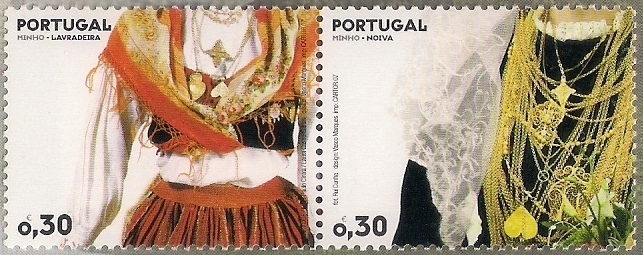
The next stamp shows the detail of a costume possibly most recognisably Portuguese on the left
2007: Regional Costumes
the bright colours of the Lavradeira  The elaborate embroidery and gold necklaces of the stamp on the right is the equivalent for a wedding.

Next we have costumes mostly associated with places of work starting

on the left with the Capa de Honras (Cloak of Honours) worn by cattle keepers and shepherds in the coldest months in the north of Portugal.  The next stamp is the Pauliteiro from the north east of the country worn by men performing a warrior dance to bagpipes. The origin of the skirt is unknown but some think it may have a Greek influence.  The embroidered ships on the next item give a clue to its origin for this is a Camisola de Pescador, a Fisherman's Shirt.  Lastly a most unusual item of clothing, the Cape of Reeds worn by shepherds (usually accompanied with a straw hat).

Heading to the seaside for the next stamp on the left

it is a costume from Nazare consists of seven skirts.  In the past the women would sit on the beach waiting for the men to return from fishing, perhaps they were counting the waves in skirt numbers (the seventh wave is always the largest). The red waistcoat on the next stamp is that of a campino, a horse backed cattle herder who manages and directs the cattle with long poles.  The next costume is from the Algarve camponesa (where there is a museum dedicated to regional costumes).  Lastly we have the Alentejo Capote, a winter coat which has a deep opening at the back to make it easier for horse riding.

An entry to Sunday Stamps II theme of - Folk or National Costumes - travel the world in costume here    
    

Sunday, 20 September 2015

Industrial Power

Germany celebrated the world's first long distance transmission and the 'Centenary of Three-Phase Energy Transmission' in 1991 with this rather pretty stamp.  The 175k (109 miles) of overhead cable ran from Lauffen am Neckar to Frankfurt am Main and marked the end of the "War of Currents" with the system that would span the world. The event was part of the International Electro-Technical Exhibition which took place from May to October in 1891 on the site of three former railway stations.  Lit with a 1000 lights, illuminated signs and an artificial waterfall powered by electric current (rather ironically as the whole system was hydro-powered) the crowds came to marvel.  Lauffen castle (shown on the stamp) has information boards telling the story of this great occasion but here is the story in photographs.  As they say a picture tells a thousand words so here is a drawing of the entrance to the exhibition complete with waterfall on the right.
For another of those light-bulb moments this set of stamps
 
was  issued for 'Industry Year' in 1986 showing a light bulb and a north sea drilling rig (energy), A thermometer and pharmaceutical lab (health)
A garden hoe and steelworks (steel) and lastly a loaf of bread and cornfields (agriculture). 

The stamps were designed by Keith Bassford (1949-) a graphic designer who was actually employed by the British Post Office in 1976, first for the corporate section and then later moving into stamps and philatelic products. I can't see that happening nowadays when their first thought seems to be to go to the photographic library and stick it on a stamp with the minimum of design effort. Bassford's expertise in stamps and philatelic products meant he used to be a popular speaker to specialist organisations.  Moving to Denmark in 1986 he continued to produce stamps for Royal Mail but also for the Danish Post Office and his work is exhibited in Denmark's Graphic Museum located in Odense (birth place of Hans Christian Andersen) who from their publicity photograph seem to have some cracking old printing presses.  The city is also home to Keith Bassford and his wife's studio where he continues with graphic design and letterpress printing.  He also has some interesting old typefaces featured on his Flickr account here although sadly his enthusiasm must have run out at that point because there is nothing else on his account.

An entry to Sunday Stamps II theme of  - Technology/Industry - for more bright sparks go here

Sunday, 13 September 2015

Linking Bridges

Here is the Clifton Suspension bridge airily spanning the Avon river gorge in Bristol and one of the iconic bridges of Britain.  It was Isambard Kingdom Brunel's first major commission when he won the competition to design a bridge over the gorge at just 24 years old and he was appointed project engineer.  Construction was delayed for decades (1831-1864) and on his death in 1859 after a glorious engineering career it was felt by the Institute of Civil Engineers that the completion of the bridge would be a fitting tribute to their colleague.  Designed for pedestrians and horse drawn traffic the structure today carries traffic that Brunel would never have envisaged.   The cover celebrates its 150 years in 2014
with one of the bicentenary of the birth of Brunel stamps issued in 2006.  In fact this was a set I nearly went with this week as it includes three of his bridges but then I found this autumnal FDC which I thought was much more attractive and also so appropriate for the time of year. (The stamp shows a lithograph from 1834 of the bridge).  Now let us take a train trip
This set is called "The Baltic Railway Bridges" and was a joint issue between the three Baltic states. The Estonian cover features a black and white photo of the concrete Sindi rail and road bridge over the River Pärnu which opened , as they say "festively" in February 1928, the traffic regulated by a bridge guard.  I like the double header stream trains.  The cancel is of the Ahja Railway Bridge on the Tartu-Petseri Railway completed in 1931.  But lets look at the stamps left to right.
The first shows Estonia's Narva Bridge, the first built to span the river was in 1869, a stronger one had to be built next to it in 1902 but was destroyed in World War I. A new rail bridge, and the last iron bridge built in Estonia, was opened in December 1923 (162 metres) but destroyed in World War II as indeed was most of the city of Narva by either the Russians or the Germans. (I can't work out whether they have rebuilt this bridge or replaced it as all the photos I've found seem to show a different shape). However I am sure about the sparklingly new Swiss built Stadler FLIRT passenger train shown on the stamp which Estonia had ordered to replace their old trains and expected to be in use soon after the stamp issue but they eventually all came into service in 2013.
The middle stamp is Latvia's Carnikava Bridge, a metal bridge over the Gauja built in 1950 (220.8 metres). A rather nice picture showing it in context appears on Panoramio here
Lastly is Lithuania's longest and highest bridge, the Lyduvinai shown with an equally long goods train.   This stamp issue links three countries but the next stamp shows a bridge directly linking two countries
Liechtenstein with Switzerland ,and is part of the second issue of "Bridges Bring Together" featuring foot and cycle bridges. To journey between the two countries over the Rhine (which marks the border) at one time required a ferry and it was not until 1868 that a bridge was built but it burned down in 1894, the next wooden bridge built in 1896 collapsed with a fire. No wonder they turned to concrete for the present one.
The stamps and maximum cards show two view  of the Rhine Bridge
which links Bendern (Liechtenstein) and Haag (Switzerland).  Guess we are in high summer when the photo on the card was taken, which would be the ideal time to take a cycle ride.
Buchs to Schaan Bridge
This 132 metre bridge is a happy spin off from a large construction project and is the visible part of 6 kilometres of  an underground steam pipeline which brings process steam from a refuse incineration plant in Buchs (Switzerland) to industry in Liechtenstein.
Who would guess that from this peaceful view?. 

An entry to Sunday Stamps II theme - Bridges to Anywhere - cross over here to see more.           

Sunday, 6 September 2015

Underground Overground

For this week's Sunday Stamps theme I'm going with the mining aspect mainly because I think I've shown most of my mineral stamps before.  Where better to start than South Africa who over the years have issued a lot on this theme, although I only have some early examples such as this definitive stamp from the 1930s of a Gold Mine.
Here comes the next process of heating and pouring the gold. If the tourist heads to Gold Reef City, Johannesburg you can take a ride on a miniature railway, and go underground to see the gold and then watch a gold pour.  Not sure that it will be on the same scale as that shown on the stamp.   South African mines hold 50% of the world's gold reserves but of course the other thing the country is famous for is
diamonds and one makes an appearance on the 1965 set for the 5th Anniversary of the Republic

1986: Rock Formations
But lets head for the light and journey above ground amongst the granite of the Paarl Mountains in the Western Cape, their name means pearl rock. 
Staying in Africa here are the tin mines of Nigeria.  When this definitive stamp was first issued in 1953 that was the year the country exported 11,942 tons of tin and earned £8.55M but with fluctuating tin prices and the discovery of oil today it is a past industry.  There is still informal mining by the locals who dig holes in the ground to access the tin but it can be a dangerous business with collapsing tunnels.  In the olden days they used to call these type of people prospectors which is where the next Australian stamp comes in
and the Broken Hill Silver Mine first prospected in 1883, the reason for its name no longer exists the hill having been mined away.  The aborigines name for the hills was the more romantic Leaping Crest.  Broken Hill (nickname Silver City) is located in the outback of New South Wales and is Australia's longest lived mining city although mining is no longer the main industry it contains the world's largest silver-lead-zinc deposits.
1955: Five Year Plan
In China here is some sort of underground machinery grinding its way along a tunnel and lastly
1954: Industrial Development
is how it all might start with the geological survey team arriving at a rock face. 

An entry to Sunday Stamps II theme of - Rocks, Gems and Minerals - discover more here      

Sunday, 23 August 2015

See the Light

2012: Norwegian Lighthouses III
The stillness of of a rolling mist coming in off the sea with perhaps the sound of fog horns and the gentle chime of buoys at sea is what these two stamps bring to mind.  The first is the wooden lighthouse near the harbour of Oslo by the whale shaped rock of Kvringen on the western seaward approach.  The island is now a protected nature reserve together with the surrounding area of shallow reefs. The tower dates from 1892.
A sunken rock in the middle of Oslo fjord is home to the 1876 Medfjordbåen light.  As might be imagined the Oslo fjord is Norway's busiest and the ferries and cargo ships are joined in the summer with all manner of recreational boats. One of the recommended experiences for the tourist is to go island hopping by ferry on the fjord.  Islands of course must mean lots of underwater hazards so there are a lot of lights on the fjord (map of them here) 
The self adhesive stamps come in a booklet of 10 and  are designed by Benjamin Stenmark.
Wooden lighthouses are unusual to me as ours tend to be sturdy stone structures but here is one at the top of Käsmu Cape in Estonia.  This is one of two preserved wooden lighthouses in Estonia and the maximum card celebrates its survival from 1892-2012.  In 2013 it opened as a museum.  This beacon was originally put in place to make sailing into the home port for the Maritime School pupils easier.
The stamp shows the position of the beacon and its latitude and longitude, then on the back of the card
is a map of it in its wider context.  The village of Käsmu sounds like an interesting place with its hiking and cycle trails, sea museum and even a replica Viking longship.

An entry to Sunday Stamps II theme - Lighthouses - for more sail into See It On a Postcard harbour here 
      

Sunday, 16 August 2015

Sunshine

An envelope plopped through my letter box on Friday and one of the things inside completely changed what I was going to show this week.  A bike bathed in sunlight by a lake, perhaps its owner is relaxing nearby with friends after a leisurely ride or even out sailing on the water. The card is called 'Summer Bike' and and has one of this year's 'Summer Feeling' stamps with whirling fluffy flowery suns. The card features a Jopo bike (a bit of a cult classic in Finland) which was first produced in 1965 and "designed for fun" by the company Helkama.  Still popular today it is handmade from Finnish steel with 24" wheels, pedal brakes and no gears which means there is not a lot that can go wrong.  
The stamp is one of five designed by Pietari Posti encapsulating a perfect dazzling summer's day with rowing, swimming, bike trips, ice cream and strawberries (full set shown here).  The appropriately named Posti graduated from Lahti Polytechnic in southern Finland but now lives in Barcelona, no doubt an excellent move if you want to guarantee perfect summer weather.  Finland seems to be having the same unreliable summer as us this year with cooler than usual temperature

An entry to Sunday Stamps II theme - That Summer Time Feeling - more sunny days here 

Sunday, 9 August 2015

Unseasonable Feast

Jersey Christmas 2013
I have heard of a few families who gather mid year for their Christmas because of the logistics of the mid winter festival when it is impossible to be in two, three or even four places at one time.  An eminently sensible idea with no pressure and a calm shopping environment to gather the ingredients for a Christmas dinner.  I was rather lacking in stamps featuring food so I'm joining that mid year idea for Sunday Stamps and in fact would happily munch my way through most of the items shown at any time of year.  The stamps are by one of Jersey Post's favourite artists - Michael Pollard and he has captured the season perfectly with its dusting of white.

 We start on the top row with 40p Christmas Pudding (traditionally made five weeks before Christmas) and so stodgy could be a meal in its own right. 45p Mulled wine which I don't really like but those mince pies would go down a treat 50p Gingerbread shown here hung on a Christmas tree and of course the season would not be complete without 55p the Christmas Cake.
Bottom:  60p Stollen or Christollen a fruit cake which seems to have been adopted in recent years, we must have been thinking ah well we pinched that Christmas tree idea from Germany what else do they have. 68p Mixed Nuts and the time for the nutcracker to make an appearance 88p a Gingerbread House, another German import and lastly 95p the Yule Log cake.

All we need now is some alcohol 
This is some very old champagne found at the bottom of the Baltic Sea in the Åland archipelago, July 2010.  The 145 bottles consisting of  Veuve Cliquot, Juglar and Heidsieck have been dated to 1840.  The stamp was issued on the day two of the bottles were auctioned off on 3rd June 2011.  Eeva wrote on the back of the card ""It is still drinkable, they say" 

An entry to Sunday Stamps II theme of - Food and Drink -see more to feast on here