Post Box Numbers LA4 247 and 248
Two pillar boxes outside the main post office in the coastal resort of Morecambe. Take your choice of which one to post your cards. I wonder if one fills more than the other.
Saturday, 22 October 2011
Sunday, 16 October 2011
Enter the Dragon (and flying horses)
If you were a stamp designer and the remit came in to produce three stamps for the National Exhibition of Industry and Communication, what would you put on the stamp? Perhaps the above stamp, with its instruments of industry, no internet or ipads yet as this is 1958. An attractive and clean design. But wait a minute, what if there are two of you brainstorming to make this an exciting event. What about dragons?
Yes the Chinese people are riding the five-toed red dragon (once the symbol of emperors) over stormy seas
And my favourite, flying horses (possibly a symbol of speed and perseverance) with their riders carrying what I can only describe as widgets over the calm sea of industry. The two Chinese stamp designers are Liu Shuoren and Wu Jiankun. Wu was greatly influenced by traditional Chinese painting and created other spectacular stamps.
I could not find what appeared in the exhibition and whether it lived up to the stamp images, apart from coming across a car message board photo requesting information on this:
The mainland of Asia is the destination of Sunday Stamps this week.
Yes the Chinese people are riding the five-toed red dragon (once the symbol of emperors) over stormy seas
And my favourite, flying horses (possibly a symbol of speed and perseverance) with their riders carrying what I can only describe as widgets over the calm sea of industry. The two Chinese stamp designers are Liu Shuoren and Wu Jiankun. Wu was greatly influenced by traditional Chinese painting and created other spectacular stamps.
I could not find what appeared in the exhibition and whether it lived up to the stamp images, apart from coming across a car message board photo requesting information on this:
The reply was "Wonderful picture of the Haiyan (Sea swallow or petrel, a little bird), developed in Shanghai in 1958. Yes, as an alternative for the pedicabs. The car was exhibited at the National Exhibition of Industry and Communications in Beijing 1959. There are different sources describing the technical info: 248cc, or 400cc, or 579cc; 1-cylinder or 2-cylinder engine; 12hp; 75km/h or 80 km/h. One source gives the Shanghai Bus Repair Corporation as manufacturer". Not quite a dragon or flying horse but rather cute.
The mainland of Asia is the destination of Sunday Stamps this week.
Friday, 14 October 2011
Lisbon
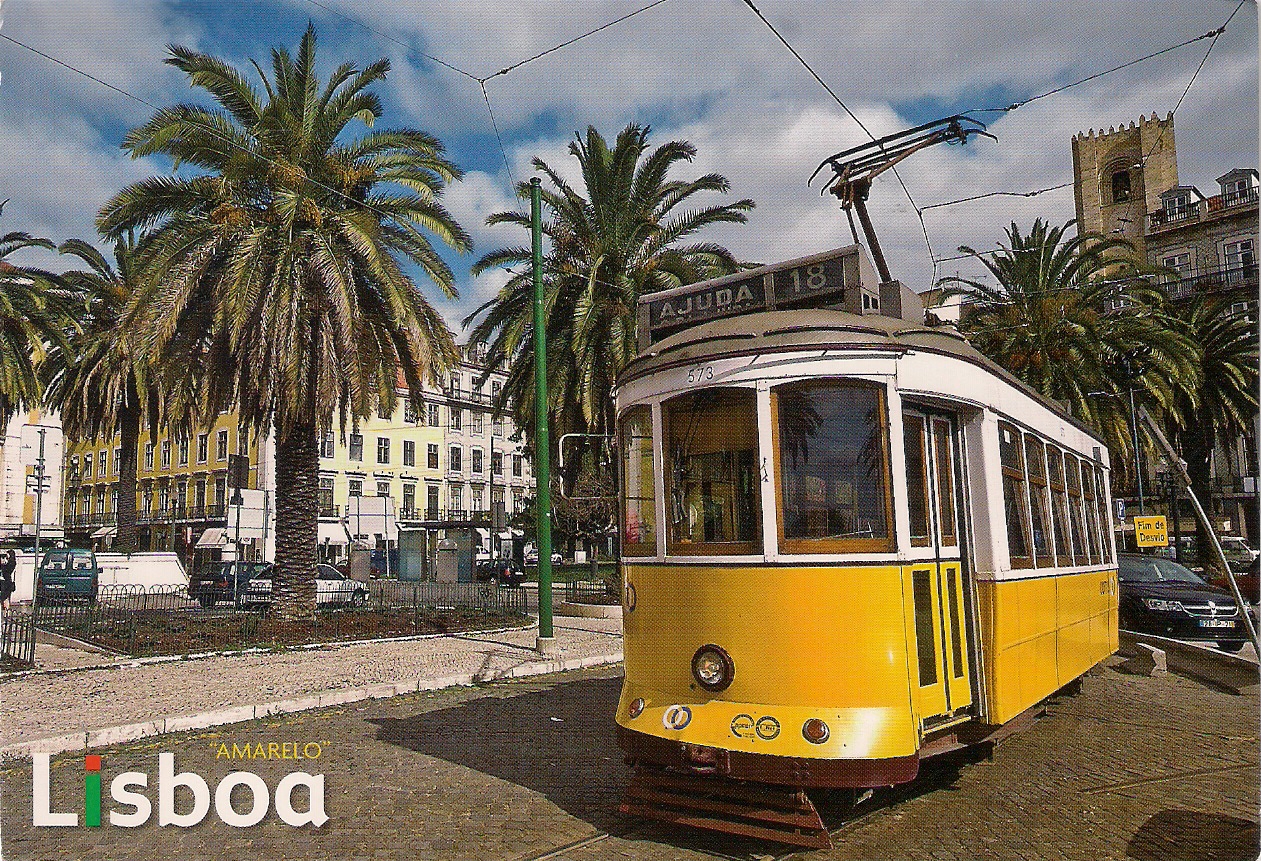
When I did a swap with Clau in Portugal of course the thing I asked for was a tram and she sent me the sight of this wonderful traditional tram, which I learnt from Wikipedia is a Remodelada type. Above the Lisbon/Lisboa name I nearly missed the name "amarelo" which is Portuguese for yellow. Is it the tram's name or just the colour? No matter I would love to ride on it and Clau says it is very nice to travel on one of these trams and see the beautiful "old Lisbon" from the windows. Yes this Number 18 is just the ticket, imagine it whirring through the city. The trees are rather wonderful too, doesn't that just say warm weather.
The card came with
one of this year's Forest Europa stamps for the Azores. The Azores Bullfinch sings on a tree as cattle graze beneath. I think the words beneath the bird mean "Forests and Soil Protection". This stamp is part of a pretty miniature sheet
I'm glad I got the one with both bird and cows. There have been three sheets produced, one for Portugal, this one from the Azores and one for Madeira, all with their different ecology and can be used in any of the three places. They are all from paintings by the wildlife artist José Projecto who shows all three on his website along with his stunning wildlife paintings, bird song thrown in too.
The card came with
one of this year's Forest Europa stamps for the Azores. The Azores Bullfinch sings on a tree as cattle graze beneath. I think the words beneath the bird mean "Forests and Soil Protection". This stamp is part of a pretty miniature sheet
I'm glad I got the one with both bird and cows. There have been three sheets produced, one for Portugal, this one from the Azores and one for Madeira, all with their different ecology and can be used in any of the three places. They are all from paintings by the wildlife artist José Projecto who shows all three on his website along with his stunning wildlife paintings, bird song thrown in too.
Thank you Clau for both for showing me Lisbon and the Azores, two places I would love to visit.
Location:
Ajuda, Lisbon, Portugal
Monday, 10 October 2011
A Picnic Toast
It is not quite the weather for picnics at the moment but we have had a brief Indian Summer when all these picnickers could have sat down, there have been plenty of mushrooms. So pass the cowslip wine, I might help myself to one of those sandwiches too and, as it seems to be all friends together, I might fulfil a lifetime ambition and stroke a bee.
Denise attached lots and lots of wonderful stamps onto this card, including three different New Year stamps which Canada does so well but I am going to save those for a Lunar New Year post as they deserve to be the highlight of a day to themselves. That was not all for there were three of the delightful Beneficial Insects series, of course we are talking beneficial to humans not to their fellow insects.
This the accurately named Assassin Bug who could be a feature of a horror film as it uses its beak to suck the body fluids out of its victims but a gardener would be happy to see it land. Keith Martin who designed this series used a strong light source to cast an assassin shadow and stand out from the foliage.
This next set (top) is the pretty Golden-eyed Lacewing according to Canada Post "Often found fluttering slowly around a front porch light, this insect, with its thin, bright-green body and sweeping, translucent wings, is a gentle friend to humans". Its larvae are voracious predators who are used as an alternative to pesticides, hence their appearance on the first of this series of stamps in 2007.
Next we are back to the 2010 insects of the garden here the sociable Paper Wasp who get their name from the nests which are made by chewing wood fibre and formed into a paper-like comb of hexagonal cells.
Denise attached lots and lots of wonderful stamps onto this card, including three different New Year stamps which Canada does so well but I am going to save those for a Lunar New Year post as they deserve to be the highlight of a day to themselves. That was not all for there were three of the delightful Beneficial Insects series, of course we are talking beneficial to humans not to their fellow insects.
This the accurately named Assassin Bug who could be a feature of a horror film as it uses its beak to suck the body fluids out of its victims but a gardener would be happy to see it land. Keith Martin who designed this series used a strong light source to cast an assassin shadow and stand out from the foliage.
This next set (top) is the pretty Golden-eyed Lacewing according to Canada Post "Often found fluttering slowly around a front porch light, this insect, with its thin, bright-green body and sweeping, translucent wings, is a gentle friend to humans". Its larvae are voracious predators who are used as an alternative to pesticides, hence their appearance on the first of this series of stamps in 2007.
Next we are back to the 2010 insects of the garden here the sociable Paper Wasp who get their name from the nests which are made by chewing wood fibre and formed into a paper-like comb of hexagonal cells.
Sunday, 9 October 2011
Russia
I am travelling to eastern Europe this week to the vastness of Russia. When these stamps were issued in 1961 they were part of a series called "Provincial Costumes", the provinces in question were part of the Soviet Union. Now both the place of this first stamp, Georgia, and this one
of Byelorussia are countries in their own right. What a century of change Russia and eastern Europe has experienced, shifting borders, wars, social change and revolution.
Throughout the post has got through although I am not sure what these Young Pioneers are doing with this postbox in 1936.
An entry to Sunday Stamps sojourn in Europe
of Byelorussia are countries in their own right. What a century of change Russia and eastern Europe has experienced, shifting borders, wars, social change and revolution.
The imperial Russian eagle of 1889
1943 Teheran Three Powers Conference and 26th Anniversary of the Russian Revolution.
Throughout the post has got through although I am not sure what these Young Pioneers are doing with this postbox in 1936.
An entry to Sunday Stamps sojourn in Europe
Saturday, 8 October 2011
Giggle Alley
Post Box Number CA19 56
I could not resist taking a photo of this postbox with the Giggle Alley sign, unfortunately the mailbox is not called the giggle box but by the more prosaic name of Eskdale Post Office box.
Location:
Eskdale, Holmrook, Cumbria, UK
Sunday, 2 October 2011
Aerial Post
Sunday Stamps trip round the world is spending two weeks in Europe so this week I am at home with this miniature sheet issued in September to commemorate the first UK Aerial Post. So easy today to stick an air mail sticker on an envelope, pop it in the box and away it flies to another country. These stamps take us back to another age and the day of 9th September 1911 when Gustav Hamel flew from London Hendon Aerodrome to Windsor Castle as part of the celebrations for the coronation of King George V (an enthusiastic stamp collector). The idea of Walter Windham who thought this would be the ideal occasion for the promotion of aerial post. He had experimented with a flight in India earlier in the year.
Things did not go too smoothly on the appointed day, the weather was very windy and of the four pilots only the German Gustav Hamel was able to get his Blériot XI monoplane aloft. He made a pass over the aerodrome which excited the crowd, who had paid between sixpence and five shillings to view the event, and he set off for Windsor Castle, (the journey of 21 miles took just 15 minutes) where another large crowd had gathered to welcome the flight. The next day was Sunday so no flights took place (no Sunday shopping in those days). On Monday four flights were scheduled but this time Hamel was flying a Farman biplane which was too heavily loaded with eight bags of mail, it crashed from a height of 40 ft and Hamel broke both legs on impact. The other three pilots continued the service, after striking to ensure Humel received compensation for his injuries. A total of 16 flights took place during the week carrying 37 bags of mail. With one plane lost and various departures cancelled due to heavy rain the regular airmail services did not happen again until after World War I when aviation technology had advanced to be more reliable and able to operate in adverse weather conditions.
The stamps feature:- 1st Hamel receiving the first mail bag, 68p Hamel in the cockpit; £1 the British pilot Clement Gresswell's Bleriot plane and lastly, £1.10 showing the mail arriving at Windsor. The miniature sheet also shows the actual advertising poster used for this historic event, a short one but the world's first scheduled airmail service.
An entry to Sunday Stamps journey round the contintents
Things did not go too smoothly on the appointed day, the weather was very windy and of the four pilots only the German Gustav Hamel was able to get his Blériot XI monoplane aloft. He made a pass over the aerodrome which excited the crowd, who had paid between sixpence and five shillings to view the event, and he set off for Windsor Castle, (the journey of 21 miles took just 15 minutes) where another large crowd had gathered to welcome the flight. The next day was Sunday so no flights took place (no Sunday shopping in those days). On Monday four flights were scheduled but this time Hamel was flying a Farman biplane which was too heavily loaded with eight bags of mail, it crashed from a height of 40 ft and Hamel broke both legs on impact. The other three pilots continued the service, after striking to ensure Humel received compensation for his injuries. A total of 16 flights took place during the week carrying 37 bags of mail. With one plane lost and various departures cancelled due to heavy rain the regular airmail services did not happen again until after World War I when aviation technology had advanced to be more reliable and able to operate in adverse weather conditions.
The stamps feature:- 1st Hamel receiving the first mail bag, 68p Hamel in the cockpit; £1 the British pilot Clement Gresswell's Bleriot plane and lastly, £1.10 showing the mail arriving at Windsor. The miniature sheet also shows the actual advertising poster used for this historic event, a short one but the world's first scheduled airmail service.
An entry to Sunday Stamps journey round the contintents
Subscribe to:
Posts (Atom)